
Against Monopoly
defending the right to innovate
Monopoly corrupts. Absolute monopoly corrupts absolutely.
Copyright Notice: We don't think much of copyright, so you can do what you want with the content on this blog. Of course we are hungry for publicity, so we would be pleased if you avoided plagiarism and gave us credit for what we have written. We encourage you not to impose copyright restrictions on your "derivative" works, but we won't try to stop you. For the legally or statist minded, you can consider yourself subject to a Creative Commons Attribution License.
current posts | more recent posts | earlier posts
Modesty
Crosbie Fitch has been posting interesting comments here for a while, but talk about not blowing your own horn. He hasn't mentioned that he also posts regularly at Digital Productions on IP issues. Check it out.
[Posted at 07/23/2008 09:27 AM by David K. Levine on Blogroll  comments(1)]
"Piracy" as a Source of Innovation
The Economist (July 19) has two articles on "piracy" and innovation,
"Look for the Silver Lining", p. 23, and
"Thanks, Me Hearties", p. 74.
Both articles note that record companies are using stats about file-sharing network traffic to learn where new singers are most popular, so they can target their marketing and advertising more effectively. TV programmers can do the same thing.
"Silver Lining" cites Bill Gates' point that "piracy" enables Microsoft to compete more effectively against open source software such as Linux.
It also mentions Matt Mason's book The Pirate's Dilemma, where he mentions a Japanese designer who removed the "whoosh" mark from Nike's Air Force trainers, slapped on his own design, and sold them for a premium price under his own brand. Instead of suing him, Nike saw an opportunity and invested in his firm, then started its own premium remix brand.
Matt Mason says the copied should innovate anew by copying the "pirates" path. Imitation can indeed be a form of innovation, as Michele Boldrin and David K. Levine show in Against Intellectual Monopoly.
Here is Matt Mason speaking about the pirate's dilemma; here is a blog related to his book: "The Pirate's Dilemma".
[Posted at 07/20/2008 06:04 PM by William Stepp on Innovation comments(1)]
Patents are a disincentive to innovation and thus violate the constitution
One of the factors missing from discussions of the cost of out patent system is hard data dollars and cents of what it costs society. Some of us have long known that it was a net loss, but that is hard to argue when you don't have the numbers. That has just changed, according to a book review by Timothy B. Lee link here. The book reviewed is Patent Failure: How Judges, Bureaucrats, and Lawyers Put Innovators at Risk by
James Bessen and Michael Meurer .
The hypothesis actually tested was, "Patents are supposed to create a positive incentive for innovation by enhancing the profits of companies that develop new technologies. If the patent system is working properly, the average firm's patent portfolio should generate more profits than the total cost of defending against patent infringement lawsuits from other firms. If, in contrast, litigation costs exceed patent profits, that suggests the patent system is actually creating a net dis-incentive to innovation. In that case, innovative companies would be better off with no patent system at all."
"Their data suggests three broad conclusions. First, patent litigation began rising sharply in the early 1990s. The costs of defending against patent litigation for non-chemical firms held steady at about $2 billion per year during the 1980s, but by 1999 (the last year for which they have reliable data), patent litigation was costing defendants more than $10 billion annually. Second, while the chemical and pharmaceutical industries also experienced increased litigation during the 1990s, the problem was much less dire; the patent system still appeared to offer positive innovation incentives for drug and chemical firms."
"Most shockingly, Bessen and Meurer's data suggest that outside of the chemical and pharmaceutical industries, litigation costs for the average public firm actually exceed profits from their patent portfolio by a wide margin. By 1999, the last year in their sample, defending against patent lawsuits cost non-chemical public firms about $12 billion, while their patent portfolios generated only about $3 billion in profits. This data suggests that outside the chemical and pharmaceutical industries, the patent system actually reduces the net returns to innovation; firms don't earn enough from their patents to offset the costs of defending themselves against patent infringement lawsuits brought by other firms."
There are some caveats to the study, so more work needs to be done. But with that proviso, not just the voter (consumer) needs to think about our busted patent system, but so does business and other patent owners. They should be banging the doors down on the Congress to get this changed.
[Posted at 07/17/2008 02:28 PM by John Bennett on Patents (General) comments(0)]
Apple versus the Mac Clones
Apple filed a suit against Psystar Corp., a Mac clone provider, to prevent it from selling its $399 Open Computer with copies of Apple's software.
Psystar produces its own computers, which are packaged with copies of software it owns that happened to be produced by Apple.
Read it and resolve not to buy an Apple product:
[Posted at 07/16/2008 07:59 PM by William Stepp on Software comments(0)]
Digital preservation and copyright law
The library of Congress, along with others, has carried out a study on the impact of copyright on digital preservation link. The 200 odd page report comes to the conclusion that 1) laws were enacted in an analog era, thus do not understand digital preservation; 2) there is little in the sense of mandatory preservation of digital works, like there is for paper copies at the Library of Congress; 3) archives have resorted to piecemeal agreements to digitize works instead of having blanket approval, due to copyright laws.
The report recommends in particular that the law should define "preservation institutions" that can digitize at risk copyrighted material, that they should be allowed to preserve in various formats, that they should be allowed to harvest material pro-actively, irrespectively of the medium and the type of material. In short, the preservation institutions should be granted privileges that allow them to bypass copyrights in a wholesale manner, for the sake of preservation.
Hat tip: DigitalKoans.
[Posted at 07/15/2008 08:47 PM by Christian Zimmermann on Copyright comments(0)]
Artist's resale rights? What's that?
One of the things we do not do is pay enough attention to IP developments in other countries. The Economist has a piece entitled "Sharing the wealth; Artists do battle to enrich their heirs link here." The story brings up a subject new probably to most Americans. The operative paragraph is, "For the past two years 4% of the price of a work by a living artist sold through an auction house or by a dealer has been payable to the artist. Sales of less than €1,000 (£796) are exempt, and the tax is capped for anything worth €500,000 or more. Throughout the European Union the tax is payable on sales of works by living artists or those who have died within 70 years; in Britain it is only works by living artists that qualify. The EU allowed Britain this exemption until 2012..... Damien Hirst, Britain's most commercially successful artist, [and] more than 500 signed a letter to the Telegraph urging the government to give them that right. 'Our loved ones often sacrifice a lot to support an artist in the family," [so that] Hirst and his colleagues would like to make sure it is not extended.'" That is a rich extension of copyright with no obvious benefit to society like encouraging innovation.
The Economist notes that the change will have an adverse effects on the British art market and then goes on to note that the gains are collected by only a relative few. "The artist's resale right (ARR) benefits a far smaller proportion of artists than its supporters might assume. A study sponsored by the Antiques Trade Gazette showed that, in the 18 months to August 2007, 10% of the 1,104 artists benefiting from ARR in Britain (around half of whom are British) got 80% of the pot; the bottom 30% received less than £100 each. The royalty has also proved cumbersome and costly to collect.
[Posted at 07/14/2008 09:17 AM by John Bennett on IP in the News comments(1)]
Against Intellectual Monopoly: The Book, Movie No Doubt To Follow Soon
Michele's and my book
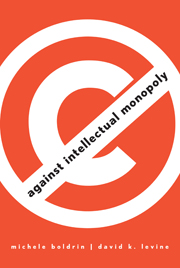
is now out...sort of. You can order it on Amazon except it appears to be temporarily out of stock. I guess that is a good thing. They have links to a few copies from other sellers. Or the publisher Cambridge University Press although they say it isn't available to August. But we know it exists, we've seen, sold and even signed a few copies. The free online version is available here
Here is the official blurb:
"Intellectual property" - patents and copyrights - have become controversial. We witness teenagers being sued for "pirating" music - and we observe AIDS patients in Africa dying due to lack of ability to pay for drugs that are high priced to satisfy patent holders. Are patents and copyrights essential to thriving creation and innovation - do we need them so that we all may enjoy fine music and good health? Across time and space the resounding answer is: No. So-called intellectual property is in fact an "intellectual monopoly" that hinders rather than helps the competitive free market regime that has delivered wealth and innovation to our doorsteps. This book has broad coverage of both copyrights and patents and is designed for a general audience, focusing on simple examples. The authors conclude that the only sensible policy to follow is to eliminate the patents and copyright systems as they currently exist.
[Posted at 07/11/2008 02:09 PM by David K. Levine on Against IM comments(14)]
Creative Commons licensed downloads
While it is still minor league, the amount of free downloadable material continues to grow. Here is one source, a website called Legal Torrents, which uses the Bittorrent software to distribute Creative Commons licensed material link here. Have a look at what is currently available here. All legal and fast to download.
The more people who come looking and download, the more licensed material is likely to be made available.
[Posted at 07/06/2008 06:25 PM by John Bennett on Against Monopoly comments(1)]
Too Much Ownership Wrecks Markets, Stops Innovation, and Costs Lives
Tyler Cowen writes on his blog about a recent book, Michael Heller's The Gridlock Economy: How Too Much Ownership Wrecks Markets, Stops Innovation, and Costs Lives, whose key message is that the "tragedy of the anti-commons" is often a bigger problem than the better-known tragedy of the commons link here.
He provides this example: "Tarnation, a spunky documentary on growing up with a schizophrenic mother, originally cost $218 to make at home on the director's laptop. It required an additional $230,000 for music clearances before it could be distributed."
Read the whole piece it is short and right on point.
[Posted at 07/06/2008 05:33 PM by John Bennett on IP as a Joke comments(4)]
Gun Rights and Copyright
Interesting post by Mike Masnick of Techdirt, Supreme Court Decision On Guns May Cut Promoting Progress Out Of The Constitution, where he worries that the reasoning in the Second Amendment case Heller--where the prefatory clause "A well regulated Militia, being necessary to the security of a free State" was not held to modify the operative clause, "the right of the people to keep and bear Arms, shall not be infringed"--on the grounds that with similar reasoning, the IP clause might be de-linked from its initial cause "To promote the Progress of Science and useful Arts..." I.e., if the first clause merely states the purpose of the power, but can be ignored, as in Heller, then Congress can still establish copyright and patent even if we can show that they do NOT promote the progress of science and the useful arts.
Well, as I wrote there, Masnick has a reasonable concern, but I think, ultimately, these clauses are different. As this post above notes, in the case of the Second Amendment, the prefatory clause does not limit the operative clause. The limit on federal power is in the operative clause.
In the case of the copyright clause, first, this is a grant of power, not a limit on power. Second, as the poster notes, the power is the power "to promote the progress of science and useful arts" by a certain means, that is, by copyright and patent grants. But the power is clearly linked to "promoting progress." So I think you could probably argue that if IP does not promote the state goals, it's ultra vires. However, I'm afraid the necessary and proper clause would be used to give the feds a lot of leeway.
[Posted at 07/01/2008 09:46 PM by Stephan Kinsella on Copyright comments(5)]


Most Recent Comments
at 07/29/2026 08:18 AM by Anonymous
at 07/29/2026 08:18 AM by Anonymous
at 07/29/2026 08:18 AM by Anonymous
at 07/29/2026 08:18 AM by Anonymous
at 07/29/2026 08:18 AM by Anonymous
at 07/29/2026 08:18 AM by Anonymous
at 07/29/2026 08:18 AM by Anonymous
at 07/29/2026 08:18 AM by Anonymous
at 07/29/2026 04:57 AM by Anonymous
at 07/29/2026 04:57 AM by Anonymous
at 07/29/2026 04:57 AM by Anonymous
at 07/29/2026 04:57 AM by Anonymous
at 07/29/2026 04:57 AM by Anonymous
at 07/29/2026 04:57 AM by Anonymous
at 07/29/2026 04:57 AM by Anonymous
at 07/29/2026 04:57 AM by Anonymous
at 07/29/2026 03:02 AM by Anonymous
at 07/29/2026 03:02 AM by Anonymous
at 07/29/2026 03:02 AM by Anonymous
at 07/29/2026 03:02 AM by Anonymous