Against Monopoly
defending the right to innovate
Monopoly corrupts. Absolute monopoly corrupts absolutely.
Copyright Notice: We don't think much of copyright, so you can do what you want with the content on this blog. Of course we are hungry for publicity, so we would be pleased if you avoided plagiarism and gave us credit for what we have written. We encourage you not to impose copyright restrictions on your "derivative" works, but we won't try to stop you. For the legally or statist minded, you can consider yourself subject to a Creative Commons Attribution License.
current posts | more recent posts | earlier posts
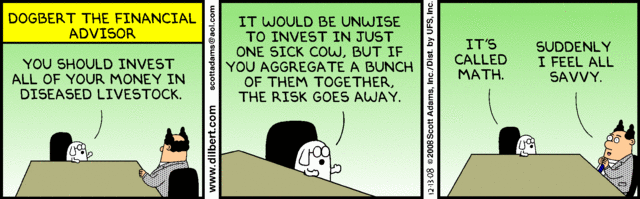
Savvy Investment Advice
[Posted at 12/14/2008 07:51 AM by John Bennett on Against IM  comments(1)]
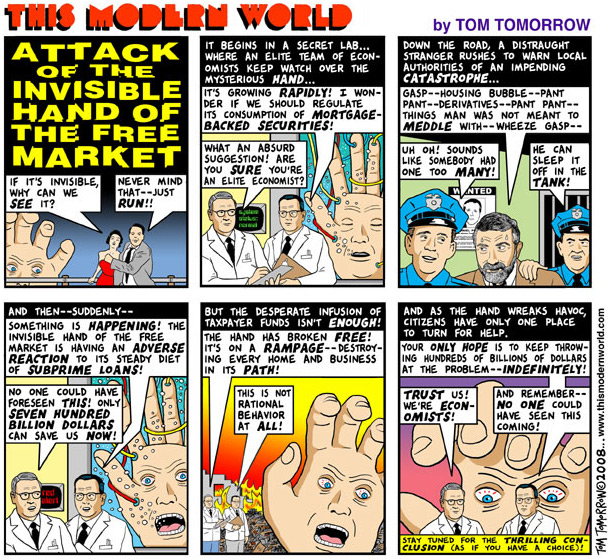
More Important Crisis Information
[Posted at 12/11/2008 07:45 AM by John Bennett on Against Monopoly comments(0)]
Groups innovate, leading to IP-based monopoly?
JANET RAE-DUPREE has a thought-provoking piece entitled "For Innovators, There Is Brainpower in Numbers" link here. She begins, "Despite the enduring myth of the lone genius, innovation does not take place in isolation. Truly productive invention requires the meeting of minds from myriad perspectives, even if the innovators themselves don't always realize it." She goes on to examine how individuals work together successfully in groups with some examples, but it led me to speculate on what this means for promoting innovation in another sense.
Since what we want is innovation, policy on IP needs to accomodate to this perception. Much innovation seems to come from large companies with the resources to devote to it. They would, I expect, prefer less regulation, such as that coming from the copyright and patent laws which fence in what they can do.
That may be wrong, however. Instead, one might argue that the really large companies with lots of patents have accomodated to the IP regime. They can cross license and largely avoid any limits on their own activities. Large companies may even find a cross-licensing regime preferable, by limiting competition. IP-based oligopoly would then be preferred to open competition.
But that bars a large number of potential innovators, whether as individuals or small groups, from doing so. In the long run we see innovation reduced or slowed. The social cost of this regime is enormous, bad for consumers and more broadly, for humanity.
[Posted at 12/07/2008 12:42 PM by John Bennett on Innovation comments(15)]
Patent Attorneys Asserting Their Own Patents
Sometimes against their own former clients.
As a followup to "Patent Hawk" Sues Microsoft, Former Client, for Patent Infringement (Against Monopoly cross-post), see the insightful Law.com article by the tenacious Joe Mullin, Some IP Attorneys Look to Make Their Mark as Patent-Holders, as well as his blog posts "Patent Hawk" lawsuit was an inside job, says Microsoft and Zilka & Kotab, a.k.a. Aloft Media, file patent lawsuit against Google's Chrome browser; the latest of many.
Cross-posted at Mises Blog.
[Posted at 12/03/2008 09:24 PM by Stephan Kinsella on Patent Lawyers comments(0)]
Patent Attorneys Asserting Their Own Patents
Sometimes against their own former clients.
As a followup to "Patent Hawk" Sues Microsoft, Former Client, for Patent Infringement (Against Monopoly cross-post), see the insightful Law.com article by the tenacious Joe Mullin, Some IP Attorneys Look to Make Their Mark as Patent-Holders, as well as his blog posts "Patent Hawk" lawsuit was an inside job, says Microsoft and Zilka & Kotab, a.k.a. Aloft Media, file patent lawsuit against Google's Chrome browser; the latest of many.
Cross-posted at Mises Blog.
[Posted at 12/02/2008 11:44 PM by Stephan Kinsella on Patent Lawyers comments(0)]
Bernanke's economics, or: the beneficial power of Fed's announcements
From the on line edition of today's New York Times:
Among the options, he said, the Fed can start aggressively buying up longer-term Treasury securities. That would have the effect of driving down longer-term interest rates. The Fed is already doing something of that sort, by buying up commercial debt from private companies as well as mortgage-backed securities guaranteed by Fannie Mae and Freddie Mac.
Investors reacted to Mr. Bernanke's remarks by pouring money into longer-term Treasury bonds, which briefly pushed already-low yields on 10-year and 30-year Treasuries to new record lows. Investors appeared to be reacting mainly to the clear signal from Mr. Bernanke that the Fed was preparing to pump money into the economy by buying up longer-term bonds.
If I, the all-powerful Federal Reserve, let you know that I will soon start purchasing asset X in order to decrease its yield (i.e. drive up its price, as X is a fixed coupon bond) what will you, the private investor, do? Well, if you are not completely drunk you will purchase asset X (Treasury bonds) today and finance it by selling asset Y (stocks) in order to capture the promised capital gains that my future purchases of asset X will create for you ... oops, by selling stocks today you are forcing their prices to drop? Life is tough, honey and we are here to make money, aren't we?
Apparently they call this kind of stuff "activist monetary policy". It is supposed to make all of us better off, and support stock market's prices. Oh yeah ...
[Posted at 12/01/2008 10:38 PM by Michele Boldrin on Against Monopoly comments(0)]
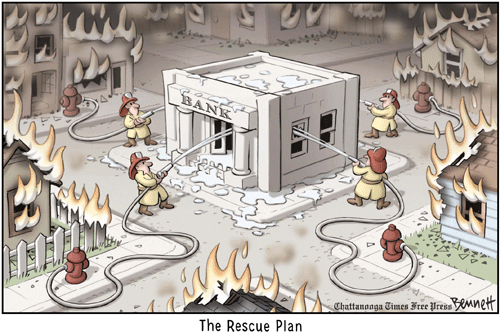
More Important Information on the Financial Crisis
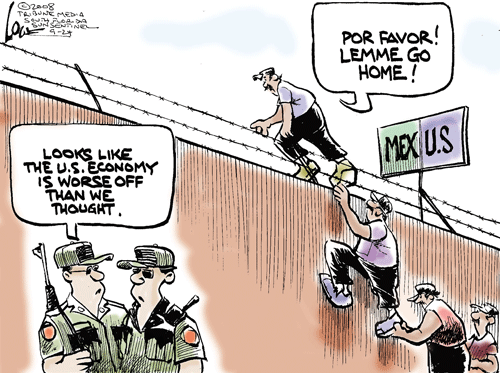
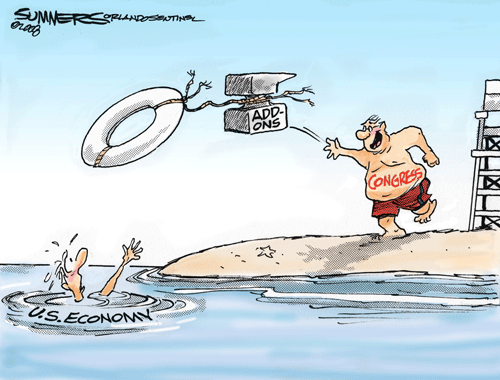
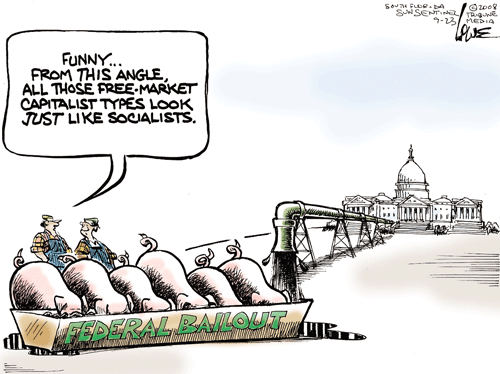
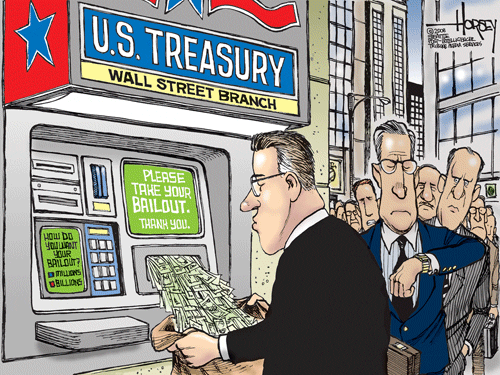
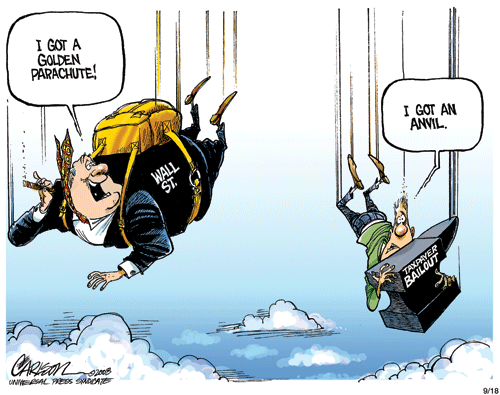
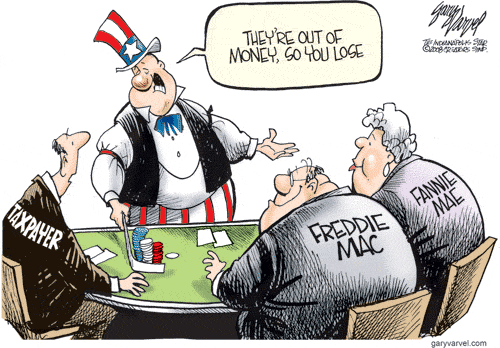
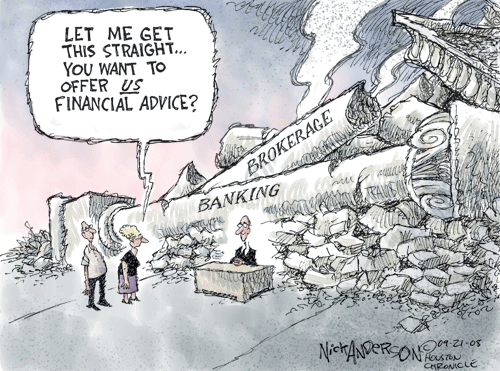
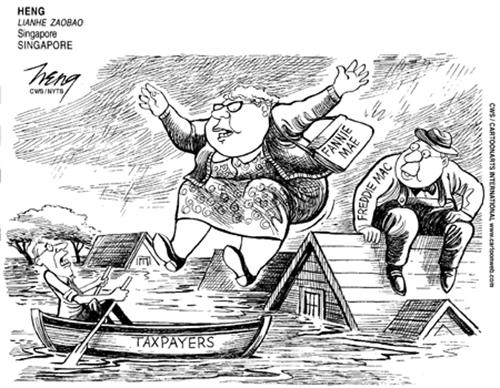
[Posted at 12/01/2008 07:44 AM by John Bennett on Ease of Imitation comments(0)]
Japanese pun the financial crisis
Financial Problems in Japan!
Following the problems in the financial sector in the US, uncertainty has now hit Japan. In the last 7 days Origami Bank has folded, Sumo Bank has gone belly up and Bonsai Bank announced plans to cut some of its branches. Yesterday, it was announced that Karaoke Bank is up for sale and will likely go for a song, while today shares in Kamikaze Bank were suspended after they nose-dived.
While Samurai Bank is soldiering on following sharp cutbacks, Ninja Bank is reported to have taken a hit, but they remain in the black. Furthermore, 500 staff at Karate Bank got the chop and analysts report that there is something fishy going on at Sushi Bank where it is feared that staff may get a raw deal.
[Posted at 11/28/2008 01:27 PM by John Bennett on Ease of Imitation comments(0)]
Google Copyright
Glenn Thorpe brings to our attention an article by Matt Zimmerman about the Google settlement with the book authors. He points out that until now Google has pursued legal settlements that benefited everyone; this time the settlement benefits only them, leaving anyone else who would like to make fair use of copyright material in the lurch.
We argue a lot about patents on this blog. While software patents are pretty clearly harmful, for the most part they aren't enforced so don't make much difference. The big blockade to innovation these days seems to be the copyright tail wagging our dog.
[Posted at 11/26/2008 08:41 AM by David K. Levine on Blocking Technology comments(0)]
$30 Billion Taxfunded Innovation Contracts: The "Progressive-Libertarian" Solution
I've noted before (2) the disturbing trend of intellectuals--some even libertarian or free marketeers--advocating taxpayer-funded "medical innovation prizes" to supplement or replace the current patent system--e.g., Alex Tabarrok's support of an $80 billion/year "medical innovation prize fund", and similar proposals by others, including Joseph Stiglitz and Forbes.com.
Now, on Cato Unbound, one "Dean Baker" has his own proposal:
I think you've got the conversation started, buddy. Congratulations! Now, can you leave us the hell aloneI do not support a prize system .... A prize system would preserve what I see as some of the worst problems of the patent system, most importantly encouraging secrecy in research. ... My ideal system would be a system in which the government allocates a pot of money (@$30 billion a year approximately equal to private R&D in the pharmaceutical sector) that would be awarded in long-term contracts to a relatively small number of master contractors. For example, there can be 10 master contractors getting grants of roughly $30 billion each spread over 10 years.
Of course this is not a perfect system and there may well be better alternatives, but the point is to get the discussion started. ... Perhaps a progressive-libertarian alliance can force economists/policy makers to take this issue seriously.
Update: Will Wilkinson, in Dean Baker on Libertarians and the Fight Against Corporatism, discussing the interchange between Dean Baker and Tim Lee, gushes, "the extent of overall agreement really is pretty impressive, and promising." Dissent!
Update2: Cato's Tim Lee writes: "I can't agree with Baker that all copyright and patent monopolies are illegitimate. Copyright and patent protections have existed since the beginning of the republic, and if properly calibrated they can (as the founders put it) promote the progress of science and the useful arts. Like any government intervention in the economy, they need to be carefully constrained. But if they are so limited, they can be a positive force in the American economy."
Ah, yes, that's our job as market liberals--to help the state "properly calibrate" its grants of pattern privilege!
Update3: On HuffPo, Baker ridicules DC intellectuals who favor the bailout, in How Do You Make a DC Intellectual Look Less Articulate Than Sarah Palin Being Interviewed by Katie Couric? Not a bad piece, but his anti-bailout credibility is undermined a bit by advocating $30B of state funding to promote innovation!
[Posted at 11/23/2008 08:53 AM by Stephan Kinsella on Innovation comments(3)]


Most Recent Comments
at 07/29/2026 08:18 AM by Anonymous
at 07/29/2026 08:18 AM by Anonymous
at 07/29/2026 08:18 AM by Anonymous
at 07/29/2026 08:18 AM by Anonymous
at 07/29/2026 08:18 AM by Anonymous
at 07/29/2026 08:18 AM by Anonymous
at 07/29/2026 08:18 AM by Anonymous
at 07/29/2026 08:18 AM by Anonymous
at 07/29/2026 04:57 AM by Anonymous
at 07/29/2026 04:57 AM by Anonymous
at 07/29/2026 04:57 AM by Anonymous
at 07/29/2026 04:57 AM by Anonymous
at 07/29/2026 04:57 AM by Anonymous
at 07/29/2026 04:57 AM by Anonymous
at 07/29/2026 04:57 AM by Anonymous
at 07/29/2026 04:57 AM by Anonymous
at 07/29/2026 03:02 AM by Anonymous
at 07/29/2026 03:02 AM by Anonymous
at 07/29/2026 03:02 AM by Anonymous
at 07/29/2026 03:02 AM by Anonymous