|
current posts | more recent posts | earlier posts The Times editorializes today on the urgent need for patent reform, but it is only likely to make the problems worse link here . Its issues with patents include award to the first to file rather than first to invent to bring us into line with the rest of world, the slowness in issuance, the amount and costs of litigation, and the large and growing backlog of applications. The Times seems to feel that the problems will be solved by allowing the Patent Office to keep all the fees it charges and to allow small businesses and inventors to file a low cost preliminary application in order to get a place in the queue.
There is no real discussion of the constitutional grounds for patents being their encouragement to innovation or the product of patents in the creation of more large monopolistic businesses.
As it stands, these measures may go through because business wants them, and its interests are reflected in the views of both parties. Too bad.
But the fact that the Times peddles propaganda like this shows how badly the media have been brainwashed by the self-serving big business propaganda that patents promote innovation, contrary to much evidence. [Posted at 03/08/2011 05:04 PM by John Bennett on Patents (General)  comments(2)] comments(2)] Via SCOTUSBlog: "Ignoring the federal government's plea to stay away from the issue, the Supreme Court agreed on Monday to rule on a core issue of copyright law: when, if ever, does Congress have the constitutional power to revive copyright protection once it has expired for a creative work?"
The is an issue of major importance that is worth keeping on top of.
More background here:
http://www.scotusblog.com/2011/03/a-major-test-of-copyright-power/ [Posted at 03/07/2011 10:30 PM by Justin Levine on IP Law comments(0)] [Posted at 03/02/2011 12:50 AM by David K. Levine on User Innovation comments(1)] I googled "ebook library" and was happily surprised to see the number of sites available. These are books you can download for free, some of them for a limited time and others indefinitely, some still covered by copyright, but others not.
Ebook publisher Harper-Collins sees this as a threat to its business and so wants to limit the number of times an ebook can be lent out link here. Mike Masnick at Techdirt observes, "two of the big publishers -- Macmillan and Simon & Schuster -- don't allow any lending of ebooks, which is unquestionably worse." He thinks such publishers will simply lose business in a publishing world that is becoming increasingly digital.
I suspect we will end up in a divided world, one part with cheap or free e books and another with expensive ones with sharply limited use. Nor would I count on big business being unable to get legislative changes that further limits user rights, all in the name of protecting authors but really to protect copyright owners who by then will be mostly "publishers". Competition might provide a better outcome, but it hasn't stopped cartels in other business lines. For the moment, however, the news is good. [Posted at 03/01/2011 12:35 PM by John Bennett on Copyright comments(0)] A hopeful story about monopoly under attack is by Julian Fisher, MD whose piece entitled Read This Academic Journal Article, but Prepare to Pay looks at the outlandishly high cost of medical journal reprints and more broadly, of scholarly journals link here.
He asks why the journals in all disciplines are so expensive and demolishes the argument that their costs are high. Authors are not paid by the publication, and the editor, normally a prestigious academic, works only for the honor. The journals ask $20-50 for reprints or require expensive subscriptions and there are lots of journals. In a limited breakthrough, "the National Institutes of Health now insists that the research they fund, when published, must be made available somewhere at no cost." Thus, that part of the government imposed monopoly has been broken. But the broad academic requirement for publication in one of those scholarly journals persists.
Fisher goes on to note, "The market has long been monopolized by mega-corporations making mega-bucks. But new business models abound. In the spirit of full disclosure, I started a not-for-profit to offer an alternative to the traditional models." That website is here
This interesting innovation is of interest to patients, doctors, and academics of all persuasions. It has been slow in coming, but there are other opportunities as well. One is the cost of textbooks. I note the price of N. Gregory Mankiw's recent rewrite of his basic economics text, Principles of Economics, "on sale" at Amazon for $199.11 with free shipping, as against the list price of $238.95.
Ah, to be an academic monopolist with what amounts to a perpetual copyright. [Posted at 02/26/2011 01:00 PM by John Bennett on Copyright comments(0)] [Posted at 02/25/2011 12:53 PM by John Bennett on Copyright comments(0)] Good Artists Copy, Great Artists Steal
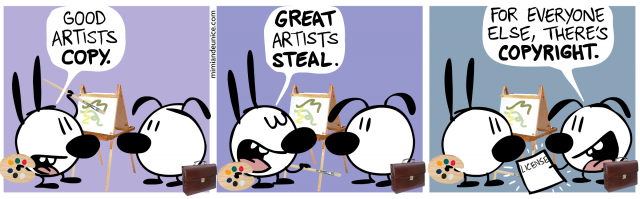
This is usually attributed to Pablo Picasso, but I'm not sure he ever actually said it. It sure has been copied a lot!
http://mimiandeunice.com/ [Posted at 02/25/2011 12:50 PM by John Bennett on Copyright comments(1)] We economists are frequently accused of making too many assumptions. As a rule we look to evidence for our facts not to assumptions. Not so the rest of the world.
[Posted at 02/25/2011 06:30 AM by David K. Levine on Copyright comments(0)] The front page of today's NYTimes carries Daniel WAKIN's story on making sheet music available for download on the internet link here(log-in required). It is quite a saga. The site is the International Music Score Library Project or imslp.org. It was started by Edward W. Guo, a music student, computer geek, and now a law student. It makes tens of thousands of scores free to download.
It started with scores that were out of copyright but has expanded to those made available under Creative Commons license. Guo was sued in 2007 by a commercial publisher of scores in Europe and had to close for a time because he didn't have the resources to fight. His solution is ingenious. He set the website up in Canada where copyright is less onerous in a separate corporation to remove personal responsibility and disclaims local legal responsibility. He warns downloaders that they are responsible for complying with their local variants on copyright. The organization is now run largely by volunteers. It arranges low cost printing services in addition to free downloads.
The economics of this is that the old line music publishers are about to become largely technologically unemployed, as their business will be increasingly reduced to publishing current works or copyrightable corrected versions of those out of copyright.
Wakins quotes both Guo's public service logic in promoting a much cheaper innovation and the defense of music publishers that their profits helped induce publishing new music. That excuse sounds pretty feeble. [Posted at 02/22/2011 02:19 PM by John Bennett on Innovation comments(0)] [Posted at 02/22/2011 11:33 AM by Justin Levine on IP Law comments(0)] current posts | more recent posts | earlier posts
|