Against Monopoly
defending the right to innovate
Monopoly corrupts. Absolute monopoly corrupts absolutely.
Copyright Notice: We don't think much of copyright, so you can do what you want with the content on this blog. Of course we are hungry for publicity, so we would be pleased if you avoided plagiarism and gave us credit for what we have written. We encourage you not to impose copyright restrictions on your "derivative" works, but we won't try to stop you. For the legally or statist minded, you can consider yourself subject to a Creative Commons Attribution License.
current posts | more recent posts | earlier posts
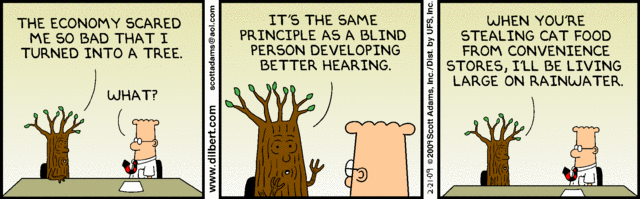
Hunkering down
[Posted at 02/22/2009 07:27 AM by John Bennett on Financial Crisis  comments(1)]
Crop Scientists Say Biotechnology Seed Companies Are Thwarting Research.
This excellent New York Times article describes how the licenses for GE seeds are preventing scientists from studying them.
Pollack, Andrew. 2009. "Crop Scientists Say Biotechnology Seed Companies Are Thwarting Research." New York Times (19 February).
"Biotechnology companies are keeping university scientists from fully researching the effectiveness and environmental impact of the industry's genetically modified crops, according to an unusual complaint issued by a group of those scientists. "No truly independent research can be legally conducted on many critical questions," the scientists wrote in a statement submitted to the Environmental Protection Agency. The E.P.A. is seeking public comments for scientific meetings it will hold next week on biotech crops."
"The researchers, 26 corn-insect specialists, withheld their names because they feared being cut off from research by the companies. But several of them agreed in interviews to have their names used. The problem, the scientists say, is that farmers and other buyers of genetically engineered seeds have to sign an agreement meant to ensure that growers honor company patent rights and environmental regulations. But the agreements also prohibit growing the crops for research purposes. So while university scientists can freely buy pesticides or conventional seeds for their research, they cannot do that with genetically engineered seeds. Instead, they must seek permission from the seed companies. And sometimes that permission is denied or the company insists on reviewing any findings before they can be published, they say. Such agreements have long been a problem, the scientists said, but they are going public now because frustration has been building. "If a company can control the research that appears in the public domain, they can reduce the potential negatives that can come out of any research," said Ken Ostlie, an entomologist at the University of Minnesota, who was one of the scientists who had signed the statement."
"The companies "have the potential to launder the data, the information that is submitted to E.P.A.," said Elson J. Shields, a professor of entomology at Cornell."
"The growers' agreement from Syngenta not only prohibits research in general but specifically says a seed buyer cannot compare Syngenta's product with any rival crop. Dr. Ostlie, at the University of Minnesota, said he had permission from three companies in 2007 to compare how well their insect-resistant corn varieties fared against the rootworms found in his state. But in 2008, Syngenta, one of the three companies, withdrew its permission and the study had to stop. "The company just decided it was not in its best interest to let it continue," Dr. Ostlie said."
"Mark A. Boetel, associate professor of entomology at North Dakota State University, said that before genetically engineered sugar beet seeds were sold to farmers for the first time last year, he wanted to test how the crop would react to an insecticide treatment. But the university could not come to an agreement with the companies responsible, Monsanto and Syngenta, over publishing and intellectual property rights. Chris DiFonzo, an entomologist at Michigan State University, said that when she conducted surveys of insects, she avoided fields with transgenic crops because her presence would put the farmer in violation of the grower's agreement."
"Dr. Shields of Cornell said financing for agricultural research had gradually shifted from the public sector to the private sector. That makes many scientists at universities dependent on financing or technical cooperation from the big seed companies. "People are afraid of being blacklisted," he said. "If your sole job is to work on corn insects and you need the latest corn varieties and the companies decide not to give it to you, you can't do your job"."
[Posted at 02/21/2009 06:10 PM by Michael Perelman on IP versus Research comments(1)]
Hacking the WTO
Peter Suber's Open Access News draws an interesting parallel between copyright laws and the World Trade Organization. The General Public License is a way to "hack" copyright laws so as to put the licensed items out of reach of copyrights. In a similar way, the General Agreement of Trade and Services, which tries to regulate the trade of services and thus expand the reach of copyright and patent laws, could be hacked to specifically put some services out of reach of such laws. The GATS lays out rules within groups of countries to commit them to agreements. The same rules could be applied to free some services from intellectual property and define rules to enforce this. Public goods, which suffer the most from patents and copyrights, are obvious candidates for such agreements.
[Posted at 02/21/2009 02:21 PM by Christian Zimmermann on Public Goods and IP comments(0)]
Abusive lawsuit using trademark law: you cannot hyperlink
Slate reports on a lawsuit that is an obvious harassment of a small company by a law firm using trademark as a pretext. In short, the suit argues, to take this post as an example, that I should not link to the Slate article like above but rather like this: Slate (http://www.slate.com/id/2210636/pagenum/all/, where the full article can be read).
Yes, you read it right, the suit argues that hyperlinking the way everyone does infringes some trademark, as it supposedly confuses readers. In my case, you are supposed to be confused into thinking that Slate would be part of Against Monopoly. The judge, who may not have heard about the web, did not dismiss this suit, forcing the poor accused party to settle before legal cost would escalate.
[Posted at 02/19/2009 04:45 PM by Christian Zimmermann on Trademark comments(0)]
200 Dead
From Glenn Thorpe a true copyright horror story. Under U.S. law government documents cannot be copyright. Under British law they are automatically copyright, and that is true in places such as Australia which use the British system. Here the true nature of copyright is more clear: of course government agencies have no greater incentive to "create" new works because the get a monopoly. Rather copyright is used to control the flow of information. This turns out is true of maps in Australia. The details can be found in this ZD article. The gist is that Google Maps was extremely helpful to people who needed to escape the fire...except for the Government maps which Google was not allowed to access - access was allowed only through the government website, which needless to say got overwhelmed by people fleeing the fire. If someone did illegally copy those government maps? Glenn suggests "Maybe they [the government] should get the RIAA lawyers involved to sue anyone left alive that obtained information on the fires from any source other than their website!"
[Posted at 02/19/2009 01:21 PM by David K. Levine on IP in the News comments(0)]
Another Reason to Diss Lincoln
[Posted at 02/17/2009 08:50 AM by Stephan Kinsella on Patents (General) comments(14)]
Too Big to Fail
Simon Johnson's appearance Friday evening on Bill Moyers Journal is generating considerable buzz in the econoblogosphere for pointing out that Too Big to Fail is simply too big. Johnson is a former chief economist for the International Monetary Fund, and continues in the interview by saying that the U.S. economy, with it's large, entrenched financial elites, reminds him more of the problems of oligarchy associated with developing economies that are frequent clients of the IMF.
I'm posting this here because one way to view the problems that our government (both under the prior admininstration, and, apparently, under the current one) is having with nationalizing the big, failed banks is precisely the inefficiency that David and Michele identify in their book: the entrenched elites, failures though they are in their own businesses, still have enough political clout and resources to lobby against direct federal take-overs of their failed institutions.
Johnson goes on to recommend increased antitrust scrutiny along the lines of Teddy Roosevelt's trust busting campaigns against the last century's robber barons. The interview is well worth watching.
[Posted at 02/16/2009 09:01 AM by Stephen Spear on Against Monopoly comments(0)]
A Patent Pool
According to the Guardian there has been a promising development in the area of pharmaceutical patents: GlaxoSmithKline is starting a patent pool for neglected diseases and third world diseases, as well as substantially discounting medicines for the third world. On the one hand the need for a patent pool gives some indication of the R&D gridlock that has been caused by patents. On the other, patent pools have historically(for example in the steel industry) helped break some of the gridlock. (hattip to Ernie Berndt.)
[Posted at 02/15/2009 08:44 PM by David K. Levine on Pharmaceutical Patents comments(1)]
This says it all

[Posted at 02/15/2009 10:39 AM by John Bennett on Financial Crisis comments(0)]
Newton and IP
I'm reading a great book, Einstein's Mistakes (google version), by Hans Ohanian. Extremely intelligent physicist and fun writer--very opinionated and spins great narratives of Galileo and Newton as a prelude to discussing Einstein. The book is about all the mistakes Einstein made in his discoveries and papers, how he made his great insights sometimes despite the mistakes, and even sometimes because of them.
Ohanian acknowledges Isaac Newton as "the greatest physicist of all times" and "the greatest genius the world has ever known", albeit a "mad scientist" and "the most awesome and the most aful physicist of all times." I was struck by this fascinating account of Newton's views on credit for scientific discoveries (pp. 62-63):
Newton held the odd notion that whenever he discovered some new result in physics or mathematics, it became his personal property, which he was entitled to keep as a secret for as long as he chose, without any need to publish it to establish his priority. If another scientists later made the same discovery independently and published it first, Newton regarded this as trespass and as theft, and he would indignantly refuse to allow such a scientist any share of the credit. ... In Newton's days, the criterion for credit for a discovery was not yet rigidly established. Claims for unpublished discoveries were sometimes accepted, especially if the scientist had the vociferous support of influential friends and patrons--sometimes the early bird got the worm, and sometimes the squeaky wheel got the grease.
Newton's secretiveness about his discoveries led him into many silly but savage disputes with other scientists about what they knew and when they knew it. Driven by his intense paranoia about his scientific accomplishments, he accused Robert Hooke, Gottfried Leibniz, and other scientists and mathematicians of stealing ideas from him. In his treatment of these scientists he was vicious and vindictive. Hooke was a talented scientist, best known for his investigations with microscopes, but he was a dwarfish man, with a stooped back. When Hooke asked for an acknowledgment that he had anticipated some of Newton's investigations of the colors in sunlight, Newton wrote a sarcastic refusal, in which he made an oblique reference to Hooke's diminutive size: "If I have seen farther, it is by standing on the shoulders of Giants."
The German mathematician and philosopher Leibniz discovered the calculus independently, and, in contrast to Newton, he published his discoveries--by the modern criterion, Leibniz would have had full credit for the calculus and Newton none. But when Leibniz asked a committee of the Royal Society to prepare an impartial report judging his share in the invention of the calculus, Newton not only packed the committee with his cronies, but he also wrote the report himself, and then wrote a favorable anonymous review of the report. In his private journal he gleefully recorded that he had bested Leibniz and "broke his heart."
As can be seen from these remarks, Ohanian is delightfully opinionated. For other examples, see his snarky coments on Aristotle (pp. 39-40), where he says that Aristotle was popular because middle ages scholars confused quantity with quality--he ridicules Aristotle's misconceptions about the animal kingdom, and his assertions about the speed of falling bodies being proportional to their weight, without ever simply dropping two different weight objects from his hands to test out this theory. On p. xii, he acerbically criticizes botched translations of Einstein's German writings; on p. xi, he refers to the mistakes "misguided souls imagine they perceive in [Einstein's] theories of special and general relativity"; on p. 9 and elsewhere he skewers Creationists as adherents of "delusional pseudoscientific theories"; and on p. 59 he refers offhandedly to "the usual eccentricities of Englishmen."
And I love this comment about Galileo: according to Ohanian, "Galileo had a talent for making enemies--as Koestler said, he provoked 'the cold, unrelenting hostility which genius plus arrogance minus humility creates among mediocrities.'" (p. 40)
[Posted at 02/15/2009 08:00 AM by Stephan Kinsella on Innovation comments(0)]


Most Recent Comments
at 07/29/2026 08:18 AM by Anonymous
at 07/29/2026 08:18 AM by Anonymous
at 07/29/2026 08:18 AM by Anonymous
at 07/29/2026 08:18 AM by Anonymous
at 07/29/2026 08:18 AM by Anonymous
at 07/29/2026 08:18 AM by Anonymous
at 07/29/2026 08:18 AM by Anonymous
at 07/29/2026 08:18 AM by Anonymous
at 07/29/2026 04:57 AM by Anonymous
at 07/29/2026 04:57 AM by Anonymous
at 07/29/2026 04:57 AM by Anonymous
at 07/29/2026 04:57 AM by Anonymous
at 07/29/2026 04:57 AM by Anonymous
at 07/29/2026 04:57 AM by Anonymous
at 07/29/2026 04:57 AM by Anonymous
at 07/29/2026 04:57 AM by Anonymous
at 07/29/2026 03:02 AM by Anonymous
at 07/29/2026 03:02 AM by Anonymous
at 07/29/2026 03:02 AM by Anonymous
at 07/29/2026 03:02 AM by Anonymous