If we want to replace the present centralized economy of waste production and planned obsolescence, it's an inescapable fact that a great deal of excess manufacturing capacity cannot be saved. In my opinion it's a mistake to try to prop it up through expedients like the Detroit bailout.Corporate capitalism has been plagued from its late-19th century beginnings with chronic crises of overaccumulation and overproduction, which would probably have destroyed it in the Great Depression (despite the New Deal) had WWII not postponed the crisis for a generation by helpfully blowing up most of the plant and equipment in the world outside the U.S. and creating a permanent war economy for absorbing surplus output. But Europe and Japan rebuilt their industrial capital by 1970, and since then the chronic crises have been back with a vengeance. Before the current downturn, America's overbuilt industry couldn't dispose of its full output running at capacity, even with everybody tapping into home equity and maxing out their credit cards to replace everything they owned every five years. And we'll never see those levels again. So there's no escaping the fact that much of our plant and equipment, in a few years, will be rust.
The goal should be a shift from the present system of overaccumulated, centralized, oligopoly industry, and its business model of planned obsolescence and "push" distribution, to a decentralized economy of small-scale manufacturing for local markets. This means, among other things, a switch from capital-intensive production methods based on product-specific machinery, to production with small-scale, general purpose machinery. It means, in place of the old Sloanist production model, something like the present-day economy of Italy's Emilia-Romagna region: networked small manufacturers producing for the local market, with a high degree of cooperative ownership. Such an economy, based on a "pull" distribution model with production geared to demand on a just-in-time basis, will be insulated from the boom-bust cycles of the old national "push" economies. And we need a new model of user-friendly, modular product design aimed at cheap and easy repairability and recycling.
Your main focus, in my opinion, should be to ease the transition by eliminating present policies (market-distorting subsidies, privileges, and cartelizing regulations) that impede it and protect the old economy from the new one.
This means, for one thing, eliminating differential tax exemptions that favor firms engaged in centralized, large-scale, capital-intensive production: e.g., the depreciation allowance, the R&D credit, the deductability of interest on corporate debt, and the exemption of stock transactions involved in mergers and acquisitions from capital gains tax). Then lower the corporate income tax enough to be revenue-neutral.
It means, especially, eliminating the biggest subsidy to economic centralization, and to artificially large market area and firm size: i.e., subsidies to long-distance transportation. The Interstate should be funded entirely by weight-based user fees on trucking, which causes virtually all of the roadbed damage. All subsidies to new airports or to expanding old ones should be eliminated, including all federal guarantees of local bond issues.
Perhaps most important of all, it requires radically scaling back the present strong "intellectual property" regime. IP (through patent pooling and exchange, monopolies on current production technologies, etc.) is probably the single most powerful cartelizing force, which enables each industry to be concentrated in the hands of a few players. It impedes the transfer of skills and new technology from the old manufacturing dinosaurs to the kinds of small, local producers we need. It also serves as a powerful bulwark to planned obsolescence, imposing legal restrictions on the manufacture of cheap generic replacement parts.
Scaling back IP law (a good start would be repealing the DMCA, the WIPO Copyright Treaty, and the Uruguay Round's TRIPS accord) would eliminate the barriers to the diffusion of skill and technology that currently prop up the old corporate dinosaurs of the software and entertainment industries, and facilitate their replacement by networked production on an open source model. Please cut loose the MPAA, RIAA, and Bill Gates, and do so yesterday!
Finally, we need to eliminate all subsidies to large-scale agribusiness. The result will be a flourishing sector of community-supported agriculture, replacing the old agribusiness dinosaurs as fast as new ground can be cultivated.
Against Monopoly
defending the right to innovate
Monopoly corrupts. Absolute monopoly corrupts absolutely.
Copyright Notice: We don't think much of copyright, so you can do what you want with the content on this blog. Of course we are hungry for publicity, so we would be pleased if you avoided plagiarism and gave us credit for what we have written. We encourage you not to impose copyright restrictions on your "derivative" works, but we won't try to stop you. For the legally or statist minded, you can consider yourself subject to a Creative Commons Attribution License.
current posts | more recent posts | earlier posts
Mutualist Comments on IP
[Posted at 01/15/2009 09:35 PM by Stephan Kinsella on Innovation  comments(1)]
Copyright is very sticky!
I've pointed out to such people innumerable times, to little avail, that copyright is a noun, not a verb--that you don't "copyright" something--you have a copyright in your original works of authorship as soon as you write them, automatically, courtesy of federal law. No copyright notice is required. No copyright registration is required. You have the right, whether you like it or not.
Well, then, why don't you just "make it public domain," some then, a bit unreflectively, retort. The problem is, there is no clear and good way to do this.
If you use a Creative Commons license, you are actually employing the copyright the state grants you--you are putting conditions or limitations on what others may do with your works. Even if you use the least restrictive type, "Attribution," you are requiring others to do something to avoid being liable for copyright infringement.
Now, some have tried to find ways to let you abandon your copyright, or "dedicate" it to "the public." Creative Commons has a proposed "Public Domain Dedication", but: (a) it doesn't seem easy, at least for the typical user; and (b) there appear to be doubts as to whether it would work--and until it's clear that it does, it's worse than a CC license, since publishers would be afraid to rely on it. It is possible that a type of estoppel would apply, preventing the "dedicator" from complaining if someone else relied on his "dedication" to his detriment; but there is "a quirk of U.S. copyright law which grants the author of a work the right to cancel 'the exclusive or nonexclusive grant of a transfer or license of copyright or of any right under a copyright" thirty-five years later, unless the work was originally a work for hire.'" So sayeth Wikipedia; and it outlines other deficiencies of the "public domain dedication."
Creative Commons seems to recognize the potential problems with their attempt to set up a "public domain dedication"-- first, they say, "Please note that the Public Domain Dedication may not be valid outside of the United States." Well, that's no good. We do live in a global, um, world. Last time I checked, the Internet was available even outside America! Second, I had to google their site to even find it--it's not even listed in their Licenses page, or in their FAQ. They provide this method with disclaimers and no guarantees, and they bury it on their site. Hmm, tells you something.
So, what's a libertarian to do? I tend to think the CC 3.0 Attribution license is the most libertarian--it only requires you to say who wrote it--but most people would do this anyway, so that's not a huge imposition. The "non-commercial" ones prevent people from using it "for profit"--this is still a use of copyright to force people not to publish. And the "Attribution Share Alike" seeks to use one's copyright threat to force others to use this license too.
(For example, suppose you have a deal with a publisher, and you want to use a CC share-alike licensed work in your book. But the publisher you are using refuses to grant a "share alike" license. So now, you can't use the CC licensed work. I.e., if you publish your paper with a CC attribution license, the other guy can use it in his book. But if you do a share alike one, he can't. He's prevented by your copyright assertion threat.)
The d*mned government imposes this right on us and does not even provide an easy way to opt out of it or get rid of it. Ridiculous.
***
Update: In my comments to Roderick Long's post Steal This Journal!, I noted:
Roderick, If I'm not mistaken, "copyleft" is similar to the Creative Commons "share alike" license. Libertarian Papers, however, uses the Creative Commons Attribution 3.0 License. After thinking about this, it seems to me that the "Attribution" license is more libertarian than "Share-Alike" (or copyleft).
Now the new "CCO", or "No Rights Reserved," attempt to make one's work "public domain" seems the most libertarian of all, but its efficacy looks doubtful to me, and it's still embryonic as far as I can tell.
In response to Charles Johnson's (Rad Geek) suggestion that Attribution-Share-Alike (a "viral" type of copyright license, a.k.a. "copyleft") might be preferable or acceptable from a libertarian perspective, I replied:
Rad, I see the argument, but I think the best policy is just to free it up. It's a bit too paternalistic, rude, untrusting, to force others to do it like you do, to assume they'll "abuse" their power. And, it might stop the work from being re-published. We want our libertarian ideas spread far and wide. I want an editor of a book considering reprinting one of our pieces to see no obstacles. A "viral share-alike" provision could be. Let ideas be free.
Update: See Doubts Raised About Legal Soundness of GPL2
(Cross-posted at Mises Blog.)
[Posted at 01/14/2009 05:12 PM by Stephan Kinsella on IP as a Joke comments(13)]
Against Monopoly
[Posted at 01/12/2009 12:23 PM by David K. Levine on Blogroll comments(0)]
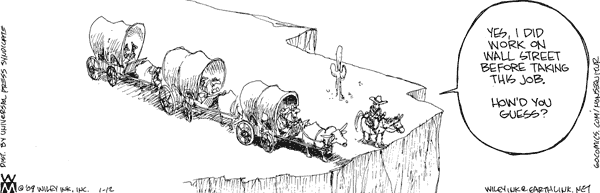
Employment?
[Posted at 01/12/2009 10:39 AM by John Bennett on Financial Crisis comments(0)]
Government Accountants Give Patent Office Award!
 The Association of Government Accountants (formerly the "Federal Government Accountants Association") has awarded the US Patent and Trademark Office its "Fiscal Year 2007 Performance and Accountability Report Award" (which looks oddly similar to the USPTO's own "red ribbon" patent grant) one of 17 federal agencies to get this award that year.
Not only does the USPTO prepare "a well structured, logically organized and easy-to-navigate report" it's very "productive" too. As it boasts on its website,
Highlights of USPTO accomplishments for the past year include ... Increased patent production by an additional 14 percent over 2007 by examining 448,003 applications the highest number in our history. Production has increased by 38.6 percent over the past four years, compared to a 21.3 percent increase in application filings during the same period.
It's sobering to think how much worse off the US would be in this recession without all this productivity.
For some more interesting patent statistics, see the World Patent Report: A Statistical Review (2008) for example, as of about 2006, there were about two million patent applications filed per years worldwide; about 750,000 patents issued (granted) every year; and about 6.1 million patents in force around the world.
(cross-posted at Mises.org)
[Posted at 01/11/2009 08:40 AM by Stephan Kinsella on Patents (General) comments(10)]
Why People Don't Believe In Paying For Music. Hint: Its All About Deflation.
"With the exception of land and human time, in all areas of society we have been conditioned to expect more for less over time. Yet until just a few years ago, the music industry was increasingly charging more, for the same product. And they were able to do this because copyright law gives them the ability to set prices like a legal monopoly. ... When people in aggregate are asked to pay far more than what they think something should cost, they start looking for alternatives. In this case, the alternative comes in the form of P2P technology."
Intriguing argument: that the failure of music to fall in price along with other technology-related goods is evidence of the pernicious effect of copyright.
[Posted at 01/07/2009 09:19 PM by Stephan Kinsella on Copyright comments(2)]
Not good news
Campaign rhetoric aside, this should be no surprise. Obama's selection of Joe Biden as vice president showed that the presidential hopeful was comfortable with someone with firmly pro-RIAA views. Biden urged the criminal prosecutions of copyright-infringing peer-to-peer users and tried to create a new federal felony involving playing unauthorized music.
[Posted at 01/07/2009 09:24 AM by David K. Levine on Copyright Sellouts comments(0)]
Googles deal on scanned books may be good for the public
"It will make it possible for users to read a far greater collection of books, including many still under copyright protection."
"According to Dan Clancy, the engineering director for Google book search, every month users view at least 10 pages of more than half of the one million out-of-copyright books that Google has scanned into its servers."
"For readers who might want to buy digital access to an individual scanned book, Mr. Clancy said, Google was likely to sell at least half of the books for $5.99 or less. Students and faculty at universities who subscribe to the database will be able to get the full contents of all the books free."
"The settlement may give new life to copyrighted out-of-print books in a digital form and allow writers to make money from titles that had been out of commercial circulation for years. Of the seven million books Google has scanned so far, about five million are in this category."
"Revenue will be generated through advertising sales on pages where previews of scanned books appear, through subscriptions by libraries and others to a database of all the scanned books in Google's collection, and through sales to consumers of digital access to copyrighted books. Google will take 37 percent of this revenue, leaving 63 percent for publishers and authors."
"Just what kind of commercial opportunity the settlement represents is unknown, but few expect it to generate significant profits for any individual author. Even Google does not necessarily expect the book program to contribute significantly to its bottom line."
Rich reports some criticisms of the settlement, but they seem small beer. That readers might decide to pass up a book based on a few pages of its text might just as likely be encouraged to read the whole thing. More telling was the concern of some libraries that the charges would price them out of the market for the service.
To me, the settlement seems like a good deal for most people, short of the abolition of copyright. Publishers are likely to suffer in the long run as the market for printed books continues to shrink.
[Posted at 01/06/2009 01:50 PM by John Bennett on Copyright comments(0)]
Goofy trademarks
[Posted at 01/04/2009 05:05 PM by Christian Zimmermann on Trademark comments(1)]
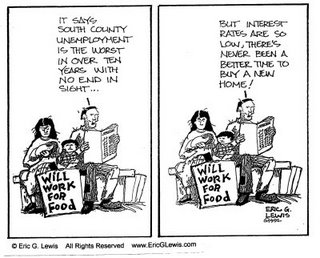
A Cartoon From 1992
[Posted at 01/02/2009 09:25 AM by John Bennett on Against Monopoly comments(0)]


Most Recent Comments