Against Monopoly
defending the right to innovate
Monopoly corrupts. Absolute monopoly corrupts absolutely.
Copyright Notice: We don't think much of copyright, so you can do what you want with the content on this blog. Of course we are hungry for publicity, so we would be pleased if you avoided plagiarism and gave us credit for what we have written. We encourage you not to impose copyright restrictions on your "derivative" works, but we won't try to stop you. For the legally or statist minded, you can consider yourself subject to a Creative Commons Attribution License.
current posts | more recent posts | earlier posts
What Public Domain?
Rufus Pollock has been looking into what the public domain doesn't look like. Here is a post with details.
[Posted at 07/04/2010 03:38 AM by David K. Levine on Copyright  comments(0)]
No Method to Patent Madness: The Supreme Court's Bilski Decision
The Supreme Court handed down this term's final four decisions today: Christian Legal Society Chapter v. Martinez, on public university limitations on a Christian student group's rights of association; the McDonald v. Chicago case incorporating the Heller gun decision against the states (Huebert's discusssion); Free Enterprise Fund v. Public Co. Oversight Bd. (a Sarbanes-Oxley decision); and Bilski v. Doll, a much-anticipated patent case.
Patent law is mind numbingly arcane, technical, and boring, so let me simplify as much as possible. This case was about what the legal test should be to determine whether certain processes can be possibly eligible for patent protection. For typical practical technical or industrial processes, it's not a difficult question. But for "business-related" methods, such as the one here--which had to do a way for commodities buyers and sellers in the energy market to hedge against the risk of price changes by following a certain mathematical formula--the question gets trickier. Courts are leery of opening the door all the way because then we'd be swamped in even more ridiculous patents than we are now (such as the attempt by Dustin Stamper, President Bush's Top Economist, to secure a patent regarding an application for a System And Method For Multi-State Tax Analysis, which claims "a method, comprising: creating one or more alternate entity structures based on a base entity structure, the base entity structure comprising one or more entities; determining a tax liability for each alternate entity structure and the base entity structure; and generating a result based on comparing each of the determined tax liabilities").
The Court of Appeals for the Federal Circuit (CAFC) tried to do this by adopting a more rigid test than had been used before. They said that a process could be patented only if it (1) it is tied to a particular machine or apparatus, or (2) it transforms a particular article into a different state or thing--this is the "machine-or-transformation test." Based on this test, the claimed business method was rejected. The problem is, this test is not in the Patent Act. So the Supremes had to take a crack at it. Now I have mentioned this case before, in The Arbitrariness of Patent Law; Supreme Skepticism Toward Method Patents; and Radical Patent Reform Is Not on the Way. This is one of these cases that had patent lawyers crying crocodile tears, gnashing their teeth, acting as if this was just part of the terrible and radical--radical!--movement to scale back patent rights. Anyway, I predicted:"I suspect the Court will choke back a bit on software and business method patents-but not too much." It was obvious from the oral arguments that the Court saw how ridiculous it would be to have an open test that allowed a lot more types of processes be eligible for protection. You could have patents on anything. So they want to choke back on this, and so did the CAFC. Unfortunately, the patent law is there. And the judges have to interpret this mess. It's not their fault, really. I don't blame them for this impossible task. As I noted in a recent post,
As I noted in Another Problem with Legislation: James Carter v. the Field Codes, there is a fascinating paper published in 1884 by James C. Carter, The Proposed Codification of Our Common Law: A Paper Prepared at the Request of The Committee of the Bar Association of the City of New York, Appointed to Oppose the Measure. This paper was an attack on David Dudley Field's attempt to (legislatively) codify New York's common law. Carter opposed replacing case law with centralized legislation. Carter notes that caselaw precedents are flexible and allow the judge to do justice (see also John Hasnas's classic The Myth of the Rule of Law), while statutes are applied literally, even where injustice is done or the legislator did not contemplate this result. Thus, Carter argues, one of the worst effects of legislatively codifying law-replacing organically developed law with artificial statutes-is that it changes the role of courts and judges from one in which the judge searches for justice into mere squabbles over definitions of words found in statutes. As he said at pp. 86-86:The point is, the judges here are merely interpreting arbitrary words of an artificial law, a statute--a written down edict of the legislature, a bunch of words that have no inner harmony, no guarantee of consistency, no relationship to justice. So you can't really criticize the courts too much for how they construe these legal abominations.At present, when any doubt arises in any particular case as to what the true rule of the unwritten [i.e., judge-found, common-law developed] law is, it is at once assumed that the rule most in accordance with justice and sound policy is the one which must be declared to be the law. The search is for that rule. The appeal is squarely made to the highest considerations of morality and justice. These are the rallying points of the struggle. The contention is ennobling and beneficial to the advocates, to the judges, to the parties, to the auditors, and so indirectly to the whole community. The decision then made records another step in the advance of human reason towards that perfection after which it forever aspires. But when the law is conceded to be written down in a statute, and the only question is what the statute means, a contention unspeakably inferior is substituted. The dispute is about words. The question of what is right or wrong, just or unjust, is irrelevant and out of place. The only question is what has been written. What a wretched exchange for the manly encounter upon the elevated plane of principle!Or, as I note in "Legislation and the Discovery of Law in a Free Society," Journal of Libertarian Studies 11 (Summer 1995), "Thus, previously, law was thought of as a body of true principles ripe for discovery by judges, not as whatever the legislator decreed. Nowadays, however, legislation has become such a ubiquitous way of making law that ‘the very idea that the law might not be identical with legislation seems odd both to students of law and to laymen.'" [Bruno Leoni, Freedom and the Law]
Back to Bilski. So the Court rejected the CAFC's holding that the "machine-or-transformation test" was the sole test for determining patent eligibility. They said that while this test "may be a useful and important clue or investigative tool, it is not the sole test for deciding whether an invention is a patent-eligible 'process.'"But they had to find a way to strike down this patent, so they did so based on an older test, one that just said you can't patent "abstract ideas." So, the Court was able to reject the narrow test of the CAFC, without having to allow this business method patent. But they wanted to encourage the CAFC that they could try to find yet other ways to limit questionable method patents: "In disapproving an exclusive machine-or-transformation test, we by no means foreclose the Federal Circuit's development of other limiting criteria that further the purposes of the Patent Act and are not inconsistent with its text." I.e., they punted: you guys figure out a better way to shut the doors a bit more, consistent with this statute.
So what do we have: we have a very slight narrowing of patent eligibility by re-use of an old "abstract idea" test; a rejection of the more bright-line, narrower but unstatutory test of the CAFC; and more legal uncertainty. And while the patent bar will use the slightest modification of patent law to cry that the sky is falling, it's not. Unfortunately.
(H/t Anita Acavalos for suggestions re the title.)
[Posted at 06/28/2010 05:42 PM by Stephan Kinsella on Patents (General) comments(22)]
Bilski and the Future of Patents
The (pro-patent) Patently-O blog does a good job in an objective analysis of what the Bilski decisions means in its practical application.
Two important posts to read from there:
http://www.patentlyo.com/patent/2010/06/bilski-v-kappos-and-the-anti-state-street-majority.html
Naturally, I'm disappointed. Although Bilski got his specific patent application rejected, and there is some hopeful wording in the opinion on the narrowing of patent eligibility, the decision for how it will practically shape future patent applications is far narrower than I had hoped for.
Like many others, I was wrong in my prediction that Justice Stevens would be writing the majority decision. He writes a lengthy and noteworthy concurring opinion, but the main decision went to Justice Kennedy, the one Justice who consistently muddies the law, rather than clarifies it with his opaque and hair-splitting opinions.
The Court punted on a once-in-a-generation opportunity. The Patent Bar must be breathing a sigh of relief.
Time for me to eat crow regarding my specific predictions on this case and think about the best way to carry the fight for meaningful reform forward.
ADDENDUM: The Christian Science Monitor provides one of the best easy-to-read quick summaries of what went down with the Bilski decision here:
[Posted at 06/28/2010 04:42 PM by Justin Levine on IP Law comments(2)]
Bilksi Patent Case - Final Predictions
Tom Goldstein, publisher of the much respected and authoritative Supreme Court blog, is making his predictions on Monday's Bilski patent ruling:
http://www.scotusblog.com/2010/06/the-final-four-decisions/#more-22266
The longest-outstanding case is Bilski v. Kappos, which involves the patentability of "business methods." Bilski was argued in November. The only Justice who has not issued a majority opinion from that sitting is Justice Stevens, which makes him the very likely author. Justice Stevens tends to take a narrow view of patent rights. He notably joined Justice Breyer's opinion in Laboratory Corp. v. Metabolite in 2006 arguing for a narrow interpretation of process patent rights, which is a similar issue.At oral argument in Bilski, Justice Stevens was very engaged. He asked counsel for the patentee the following telling question: "But is it correct that there's none - none of our cases has ever approved a rule such as you advocate?" Justice Stevens also was seemingly doubtful that the involvement of a machine could render a process patentable, and furthermore that software could be patentable, which suggests a very narrow interpretation of business method patents and that the ruling could spell significant trouble for software patents.
I ultimately predict that the Bilski majority opinion will be authored by Justice Stevens and that the decision will be very significant in its narrowing of the scope of method patents. I expect that the delay in resolving the case will have arisen not from disagreement over whether this particular invention is patentable - I think the Court will unanimously hold that it isn't - but over the scope of the rule.
[Posted at 06/27/2010 02:54 AM by Justin Levine on IP in the News comments(4)]
Bilski Decision Watch (The Final Stretch?)
Unless the Supreme Court agrees to hold the Bilski patent case over until the next term and have the case re-argued (an almost inconceivable possibility since Justice Stevens is retiring at the end of this term), the Bilski patent case will be handed down on Monday, June 28th.
Even the most ardent defenders of the current patent regime expect the Court to strike down "business method" patents. The big question will be if the Court goes even farther and delivers a broader decision affecting software patents and other controversial forms of patent monopolies.
Stay tuned...
[Posted at 06/24/2010 01:36 PM by Justin Levine on Patent comments(1)]
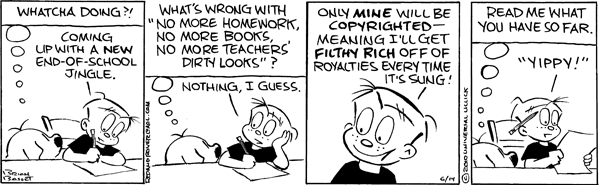
Copyright makes the comics, but who's laughing
[Posted at 06/24/2010 09:00 AM by John Bennett on Copyright comments(1)]
Bucky Fuller indicts patents
I recently saw a play about Buckminster Fuller, an inventor, inveterate writer of mixed obscure and enlightening but wordy prose, and a teacher of considerable renown among his students and the colleges where he taught. That led me to his book Critical Path where he discusses invention and innovation. A quote: "Ideas are easy to come by; reductions to practice is an arduous but inspirationally rewarding matter."
Fuller was born in 1895 and died in 1983 and so is unlikely to be widely remembered or read today. He recounts his experience with patents, concluding that it was not worth it for inventors to get patents because of their cost and the long period between the idea and its fruition in saleable goods. He summed it up, "Most of my inventions have come into public use after my patent rights have expired."
He describes one of the major costs of protecting inventions as the patent attorneys whose services are essential because, "Vast knowledge of the precedents in court-decision history and of the patent strategy of great corporations is essential in the writing of claims."
Finally he quotes the corporate attorneys speaking to his lawyer, "Of course, the first thing my client asked me to do was to find a way of circumventing your client's patent, but you have written the claims so well that I was forced to advise my client to procure a license under your patent without exposing himself to almost certainly devastating infringement expense."
Fuller finds two truths from his experience, "... big business, which now makes its major profits out of know-how, deliberately steals know-how wealth whenever possible; the second is that if I had not taken out patents, you would probably never have heard of me ...."
He gave up on inventing for money and got his rewards from the renown of his patent disputes. So much for using his experience as justification for patents as encouraging invention.
[Posted at 06/24/2010 08:49 AM by John Bennett on Patent Lawyers comments(10)]
Smirnoff's Copyright and Trademark Bullying
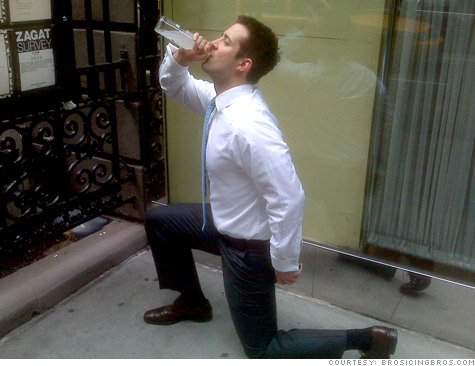 Fortune's Don't ice me, bro! When memes meet the marketplace relates the battle by Vodka peddler Smirnoff against fans of its Smirnoff Ice beverage. Apparently it had become popular with "Bros"--"a college-age person ... They like to hang out. A lot of them drink beer and wear backwards baseball caps. A lot of them drive SUVs and listen to Dave Matthews Band"--well, until Smirnoff sued them, I guess. Some frat-boy antics arose where these kids of privilege and no rhythm would "ice" each other--basically daring or challenging or pranking each other to drink a Smirnoff Ice. Then someone set up fan site brosicingbros.com, with pictures etc. of people "Icing" each other.
Good PR for Smirnoff, right? Well apparently Smirnoff didn't think so, so they threatened the site with a copyright and trademark lawsuit, so it was taken down. The case by Smirnoff is taken apart in Bros Icing Bros - A Case for Copyright Bullying by Overreacting Smirnoff Lawyers by legal non-profit called NewMediaRights, which heroically provides "free legal assistance to bloggers, journalists, and filmmakers getting bullied by companies into taking down their websites."
This reminds a bit of Ford Slaps Brand Enthusiasts, Returns Love With Legal Punch, AdRants, in which Ford Motor Company claimed it holds the rights to any image of a Ford vehicle, even if it's a picture you took of your own car.
For other IP horror stories, see The Patent, Copyright, Trademark, and Trade Secret Horror Files.
[Posted at 06/23/2010 09:05 PM by Stephan Kinsella on IP Bullying comments(1)]
Judge Rules Google/YouTube Not Liable For Posting Viacom Videos
Google Inc.'s YouTube video-sharing website didn't infringe copyrights owned by movie and television producer Viacom Inc., a judge ruled.
U.S. District Judge Louis Stanton in New York today said YouTube wasn't liable for infringement.
Details here:
http://www.businessweek.com/news/2010-06-23/google-s-youtube-didn-t-infringe-viacom-judge-says.html
More here (along with the actual ruling itself):
http://news.cnet.com/8301-31001_3-20008636-261.html
This still preserves the very flawed "safe harbor / take down notice" regime which has proven to be subject to abuse and various end runs around fair use principles, so this hardly a game changing development. But it still would have been far more disastrous had the decision come down in Viacom's favor. In that aspect, its a small step in the right direction.
[Posted at 06/23/2010 02:54 PM by Justin Levine on IP Law comments(0)]
Appeals Court: Public Domain Only Exists At The Whim Of Congress Which Can Take It Away Anytime It Wishes
A disappointing decision today from a Federal Appeals Court which held that Congress has the power to take works out of the public domain in order to satisfy international treaties.
The case is Golan v. Holder.
What is truly outrageous is that this infringes on the rights of creators who have relied on these public domain works in order to create new "derivative" works. They will now be obligated to pay money to those who hold the copyright in the (previously public domain) underlying work in order to distribute their new "derivative" work.
As the court says: "If the parties are unable to agree on reasonable compensation, a federal court will determine the amount of compensation."
Great.
This is a shameful disgrace to the free flow of information, art and expression.
Read it here:
http://www.lawweekonline.com/2010/06/10th-circuit-decides-major-copyright-case/
Updated thoughts: The ruling focuses on a First Amendment Constitutional challenge to what Congress has done. It rejects the First Amendment challenge, but I wonder if it might also be vulnerable to a (long-shot) challenge under either the Contracts or Takings clauses of the Constitution.
It theoretically might. But the problem with this theory is that it might inadvertently invite the courts to accept the flawed analogy between IP and real property. Plus, such an argument might inadvertently end up locking in the current (and outrageously long) copyright terms - effectively holding that Congress would also not be able to shorten them without financially compensating authors who had already created works with the understanding that they would be protected under the longer terms.
These are just my current random thoughts on the matter. I'd be curious to read the thoughts of other Constitutional theorists on this (amateur and otherwise).
[Posted at 06/22/2010 02:41 PM by Justin Levine on IP Law comments(1)]


Most Recent Comments
at 07/29/2026 08:18 AM by Anonymous
at 07/29/2026 08:18 AM by Anonymous
at 07/29/2026 08:18 AM by Anonymous
at 07/29/2026 08:18 AM by Anonymous
at 07/29/2026 08:18 AM by Anonymous
at 07/29/2026 08:18 AM by Anonymous
at 07/29/2026 08:18 AM by Anonymous
at 07/29/2026 08:18 AM by Anonymous
at 07/29/2026 04:57 AM by Anonymous
at 07/29/2026 04:57 AM by Anonymous
at 07/29/2026 04:57 AM by Anonymous
at 07/29/2026 04:57 AM by Anonymous
at 07/29/2026 04:57 AM by Anonymous
at 07/29/2026 04:57 AM by Anonymous
at 07/29/2026 04:57 AM by Anonymous
at 07/29/2026 04:57 AM by Anonymous
at 07/29/2026 03:02 AM by Anonymous
at 07/29/2026 03:02 AM by Anonymous
at 07/29/2026 03:02 AM by Anonymous
at 07/29/2026 03:02 AM by Anonymous