At least that seems to be Apple's strategy against Nokia.
Read about it: link here
Notice how these latest developments come only as Apple "overtook Nokia last quarter as the cellphone maker generating the highest total operating profit."
I guess that's how it usually works in today's so-called "free market" system.
This article from CNN is amazingly funny, and not in a good way -
Recession's latest victim: U.S. innovation
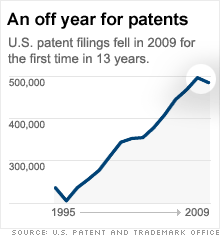
Patent filings fell in 2009 for the first time in 13 years, worrying Silicon Valley that it is losing its place as the leader in global innovation.
NEW YORK (CNNMoney.com) -- U.S. innovation slowed this year for the first time in 13 years as the recession cut into budgets, and costs to protect inventions rose.
The number of patent filings in the United States fell 2.3% in 2009 to 485,500 from 496,886 last year, according to a preliminary estimate by the U.S. Patent and Trademark Office. That makes 2009 the first year since 1996 in which businesses and inventors filed fewer patents year over year.
"That's unfortunate because [patent filings] are a reflection of innovation," said David Kappos, director of the Patent Office. "Innovation creates so many jobs and so much opportunity for our country. It is absolutely key to our long-term success in the global economy."
Most blame the recession for the drop in U.S. filings. As a result, many companies are opting to hold off on bringing new ideas to market until the economy improves substantially
Read the whole article here.
Patently-O's reaction:
"I tend to attribute huge rise in patenting activity over the past two decades more to a perceived strengthening of the patent right and less to an actual increase in innovations. In recent years, court decisions and threatened action from congress may have reduced the perceived potential value of the patent right -- thus lowering demand. Perhaps now, applicants are filing fewer 'junk' patents."
I suppose when there is an astronomical increase in patent applications for the past decade-plus, any minuscule decrease is supposed to be from a lack of 'innovation', as though patent applications should be expected to automatically increase exponentially every year - just like housing prices.
So-called 'performance reports' from the Patent office going back roughly 15 years can be found here.
Does filesharing reduce profits of the music industry?
This paper claims so, and that should not be that much of a surprise. However, it also argues that filesharing is welfare improving because it leads to more competition and thus lower prices. Remember, ultimately it is the consumer that counts when computing a surplus, not just music industry profits.
HT: Economic Logic
So says Adam Mossoff, Objectivist law professor,
here:
Just FYI, I am just about to complete my first draft of my article, tentatively titled, "A Value-Based Theory of Intellectual Property," in which I explain why intellectual property rights are a fundamental property right. In fact, my thesis can be summed up as: All Property is Intellectual Property. As far as I'm aware, this will be the first full-length academic treatment of IP that is not only based on Rand's ethical and political theory, but also contextualizes this IP theory vis-a-vis both the Lockean labor theory of property and the utilitarian scarcity theory of property.
Of course, Kinsella and the other scarcity-based advocates for property rights with the libertarian movement, such as Timothy Sandefur, are appropriately taken down in my paper. I'm presenting my draft at the APA meeting at the end of this month in NYC, and, hopefully, I'll have a draft up on the SSRN website by the spring. So, people will either have to come to the APA meeting or they'll have to wait a few more months to download a draft.
I discussed Mossoff before in Objectivist Law Prof Mossoff on Copyright; or, the Misuse of Labor, Value, and Creation Metaphors. This was posted as a comment to An Objectivist Recants on IP??, a post by Objectivist Greg Perkins, who previously wrote DON'T STEAL THIS ARTICLE: On the Libertarian Critique of Intellectual Property (discussed in my post Elaborations on Randian IP). Perkins's post was a response to the Mises post An Objectivist Recants on IP; as I noted there, and in response to him on his post:
Greg,
For those interested, I've laid out why I think the entire Objectivist case for IP is flawed and unlibertarian in various articles and posts. I list these below; I encourage those Objectivists seriously interested IP to consider these arguments.
Articles: "Intellectual Property and Libertarianism" (in particular see here and the section on Libertarian Creationism); also "The Case Against IP: A Concise Guide"; for an alternative to the Randian approach to rights and politics, see What Libertarianism Is.
Media: I discuss problems with Rand's view at length on the Peter Mac show and at the Mises University this year; also The Intellectual Property Quagmire, or, The Perils of Libertarian Creationism.
Blog posts: Rand on IP, Owning "Values", and "Rearrangement Rights"; Libertarian Creationism; Objectivist Law Prof Mossoff on Copyright; or, the Misuse of Labor, Value, and Creation Metaphors; Inventors are Like Unto …GODS…. Also these blog posts: Intellectual Products and the Right to Private Property; New Working Paper: Machan on IP; Owning Thoughts and Labor; also Elaborations on Randian IP; and Objectivists on IP.
I'm not surprised has to claim that all property is intellectual property; this is at the root of the more consistent, but extreme and absurd, views of IP, such as those of Rand and Galambos. As I noted in Rand on IP, Owning "Values", and "Rearrangement Rights":
In Jeff Tucker's superb article If You Believe in IP, How Do You Teach Others?, he notes Rand's increasing focus on exalting the creator and elevating "intellectual rights" to such a height that they totally trump real rights. This is no exaggeration. As I noted in Against Intellectual Property, Rand actually, incredibly said that "patents are the heart and core of property rights." See also my post Inventors are Like Unto …. GODS….., noting Objectivist IP attorney Murray Franck approvingly repeating this quote: "intellectual property is after all the only absolute possession in the world."
And Galambos believed that man has "primary" property rights in his thoughts and ideas, and secondary property rights in tangible goods; see Against Intellectual Property. So, for those who take IP seriously, they have to relegate property in real things to lowly secondary status, and exalt patterns, information, ideas, "values," reputations, labor, a right to profit from labor, etc. etc. So no, it's no surprise Mossoff, trying to defend this system and take it seriously, ends up concluding that all rights are intellectual property.
As noted in the various posts and articles linked above, rights in "value," patterns, reputation rights, a Marxian-type labor theory of value, etc., all arise when rights to ideas are made primary.
Of course, as Rand herself knew, men are not ghosts; as she said, "Only a ghost can exist without material property." When she was thinking clearly she also knew that there cannot really be property rights in values or "creations"; as she once wrote:
The power to rearrange the combinations of natural elements is the only creative power man possesses. It is an enormous and glorious power and it is the only meaning of the concept "creative." "Creation" does not (and metaphysically cannot) mean the power to bring something into existence out of nothing. "Creation" means the power to bring into existence an arrangement (or combination or integration) of natural elements that had not existed before.
She should have realized that this means there cannot be property rights in value since this would have to mean property rights in arrangements or patterns, which would then give the owner of the arrangement rights in other people's already-owned property. If she had kept her focus on the fact that rearranging already-existing property can indeed make that property more valuable, she would have realized that creation (rearrangement) is not an independent source of property rights: if you rearrange your own property, even if this makes it more valuable, you already owned the property that you have rearranged (made more valuable). Yet this does not give you rights in other people's property. You can re-word the Randian view as follows: if you make your property more valuable, it gives you additional property rights-the right to prevent other people from making their own property more valuable. And this makes it all the more obviously flawed.
More on this in Rand on IP, Owning "Values", and "Rearrangement Rights". The Randian system, however, applied consistently, would lead to stagnation and death, total absurdity from the point of view of justice. No action in the real world would be possible, as IP would be much broader in scope and term than now--no reason to limit IP to original artistic works (copyright) or practical inventions (patents), it would also have to cover not only reputation (another way we "create value") but abstract ideas, clothing designs, philosophical systems, anything you can imagine that "has value" ... and the term would have to last forever; it couldn't stop at 20 or 120 years. After all, property rights don't expire.
And so we would end up with a stagnant, dead society where no one was allowed to do anything, because every action would have to employ knowledge and implement patterns someone else thought of... man would be trapped in a prison of having to ask permission for every single action worse than imaginable even in the most totalitarian regime. Life would be by permission, not by right; and it would be impossible to obtain the millions of permissions needed. As I noted in Against Intellectual Property, pp. 27-28:
By widening the scope of IP, and by lengthening its duration to avoid making such arbitrary distinctions as Rand does, the absurdity and injustice caused by IP becomes even more pronounced (as Galambos demonstrates). And by extending the term of patents and copyrights to infinity, subsequent generations would be choked by ever-growing restraints on their own use of property. No one would be able to manufacture or even use a light bulb without getting permission from Edison's heirs. No one would even be able to build a house without getting permission from the heirs of the first protohuman who left the caves and built a hut. No one could use a variety of life-saving techniques, chemicals, or treatments without obtaining permission of various lucky, rich descendants. No one would be able to boil water to purify it, or use pickling to preserve foods, unless he is granted license by the originators (or their distant heirs) of such techniques.
Such unbounded ideal rights would pose a serious threat to tangible-property rights, and would threaten to overwhelm them. All use of tangible property would by now be impossible, as every conceivable use of property, every single action, would be bound to infringe upon one of the millions of past, accreted IP rights, and the human race would die of starvation. But, as Rand noted, men are not ghosts; we have a spiritual aspect, but also a physical one.[54] Any system that elevates rights in ideas to such an extreme that it overrides rights in tangible things is clearly not a suitable ethical system for living, breathing human beings. No one living can actually act in accordance with such an unrestricted view of IP. The remaining advocates of IP all qualify their endorsement by limiting the scope and/or terms of IP rights, thus adopting the ethically arbitrary distinctions noted above.
In other words, if you take a principled approach to IP, you endorse a system that condemns society to stagnation and death. So most proponents, like Rand, realizing this, start making ad hoc, unprincipled, utilitarian exceptions to avoid the most obvious, harsh consequences of a principled implementation of their confused IP ideas.
[Mises post; SK post]
The estate of jazz legend Chet Baker is suing Warner Music Canada, Sony BMG Music Canada, EMI Music Canada, and Universal Music Canada for piracy. These labels have massively used Chet Baker's works in compilations without any compensation, and they have already admitted doing so. The sought compensation is C$20,000 per infringement, which adds up to about C$60 billion.
HT: Toronto Star via BoingBoing
From my comment on this
thread:
Re the issue of the prices charged for things like apples etc.--see my post Imagining the Fate of Copyright in a Future World.
Imagine 1000 years from now, if we still have these ridiculous IP laws .... Say you need some music--to play in your department store's elevators, to go with a scene in a movie, etc.--you can choose between an almost infinite supply of older, public domain work, or pay for a new tune that is still under copyright. That will force new works' price to be almost zero.
One concern I have is that the IP socialists would at that point come up with a new IP right--basically a renewal of copyright held by someone who "rediscovers" older work forgotten in the almost infinite pile of public domain work. Imagine living in a world where Michael Jackson's work, or the music of the 70s, had been basically forgotten and lost, a needle in a haystack, surpassed by all the music over the ensuing centuries ... then some DJ starts playing it, people rediscover it anew.. shouldn't he get credit for this? After all, it takes a lot of work to loook thru all the old stuff and find "what to recommend" (a lot of IP law is based on the Marxian labor theory of value, the idea that you should be rewarded if you labor on something, as in the old "sweat of the brow" copyright law doctrine). Shouldn't the discoverer be rewarded for this? After all, if he's not, you consumers would never have heard of Michael Jackson, would not have the pleasure of knowing what (free) tracks to play at your party. What's the harm of awarding the DJ a monopoly? After all, you would never have found that needle in an infinite haystack, so no one is worse off, and everyone is better off. Copyright can never die; it only gets reincarnated. O brave new world! That has such laws in't!
Well, not exactly, but this delightful anecdote
by Taki has a quasi-Galambosian ring to it (
Galambos, you may recall, was the hyper-IP libertarian fringe personality from "California").
When the Marx Brothers announced in 1946 that their upcoming film was called A Night in Casablanca, Warner Bros threatened to sue for breach of copyright. Warner had produced the great hit "Casablanca" four years earlier, and insisted the funny men were trying to cash in on it. But Groucho was no slouch. He had his lawyer threaten Warner Brothers with breach of copyright for using the word brothers. The Marx boys won, as they were brothers before the Warners had formed the company. A Night in Casablanca turned out also to be a great hit.
Here is some pricing information for an ebook that may be of interest
Charles Darwin's A Naturalist's Voyage Round the World may be purchased in mobipocket format on the mobipocket website for $47.99
link here
Or you may "purchase" it in the same format from Gutenberg for $0.00
link here
By the way: the work is not under copyright.