Copyright Notice: We don't think much of copyright, so you can do what you want with the content on this blog. Of
course we
are hungry
for publicity, so we would be pleased if you avoided plagiarism and gave us credit for what we have written. We
encourage you not to impose copyright restrictions on your "derivative" works, but we won't try to stop you. For the legally or statist minded,
you can consider yourself subject to a Creative Commons Attribution License. |
|
current posts | more recent posts | earlier posts Taken from the Appendix to my Mises Daily article Radical Patent Reform Is Not on the Way:
Examples of Outrageous Patents and Judgments
Examples of (at least apparently) ridiculous patents and patent applications abound (more at PatentLawPractice):
- Amazon's "one-click" patent, asserted against rival Barnes & Noble
- Cendant's assertion that Amazon violated Cendant's patent monopoly on recommending books to customers (since settled)
- The attempt of Dustin Stamper, Bush's Top Economist, to secure a patent regarding an application for a System And Method For Multi-State Tax Analysis, which claims "a method, comprising: creating one or more alternate entity structures based on a base entity structure, the base entity structure comprising one or more entities; determining a tax liability for each alternate entity structure and the base entity structure; and generating a result based on comparing each of the determined tax liabilities"
- Apple's patent application for digital Karaoke
- the suit against Facebook by the holder of a patent for a "system for creating a community for users with common interests to interact in"
- the "absurdly broad patent [issued to Blackboard] for common uses of technology if that technology is employed in the context of education" (see also Patent Office Rejects Blackboard E-Learning Patent One Month After It Wins Lawsuit, Techdirt (Mar. 31, 2008)
- Compton's (now Encyclopedia Britannica's) patent that "broadly cover[s] any multimedia database allowing users to simultaneously search for text, graphics, and sounds basic features found in virtually every multimedia product on the market"
- Carfax's patent on a "method for perusing selected vehicles having a clean title history"
- Acacia's patent for putting a unique transaction number on a receipt[26]
- Pat. No. 6,368,227, covering swinging sideways on a swing
The Supreme Court, in the 1882 case Atlantic Works v. Brady, 107 US 192, itself lists examples of patents issued to "gadgets that obviously have had no place in the constitutional scheme of advancing scientific knowledge … the simplest of devices." These included
- a particular doorknob made of clay rather than metal or wood, where differently shaped doorknobs had previously been made of clay.
- making collars of parchment paper where linen paper and linen had previously been used.
- a method for preserving fish by freezing them in a container that operates in the same manner as an ice-cream freezer.
- rubber caps put on wood pencils to serve as erasers
- inserting a piece of rubber in a slot in the end of a wood pencil to serve as an eraser
- a stamp for impressing initials in the side of a plug of tobacco
- a hose reel of large diameter so that water may flow through the hose while it is wound on the reel
- putting rollers on a machine to make it movable
- using flat cord instead of round cord for the loop at the end of suspenders
- placing rubber hand grips on bicycle handlebars
- an oval rather than cylindrical toilet paper roll, to facilitate tearing off strips
Below are a few notable or recent examples of large, significant, troubling, or apparently outrageous injunctions, damages awards, and the like:
- Qualcomm has been enjoined from importing chips that help conserve power in cell phones (discussion; latest developments). See also Eric Bangeman, ITC to Bar Import of New Handsets in Patent Dustup, ars technica (June 7, 2007); Nokia's Patent-Licensing Case against Qualcomm Dropped by Dutch Court, engadget (Nov. 14, 2007); Broadcom Wins Major Injunction against Qualcomm, engadget (Dec. 31, 2007); ITC Upholds Ruling, Reiterates that Nokia Didn't Violate Qualcomm Patents, engadget (Feb. 29, 2008).
- Texas-Sized Patent Win, Texas Lawyer (Feb. 21, 2008). A New Jersey doctor was awarded $432 Million as a "reasonable royalty" against Boston Scientific for infringing his "Method and Apparatus for Managing Macromolecular Distribution."
- Smartphones Patented … Just About Everyone Sued 1 Minute After Patent Issued, Techdirt (Jan. 24, 2008).
- Farmer David Reaps What He Has Sown: A Patent Suit, Patent Baristas (Feb. 13, 2008) Even though "the practice of saving seeds after a harvest to plant the next season is as old as farming itself," patents prevent farmers from saving patented seeds.
- Apple, Starbucks Sued over Custom Music Gift Cards, AppleInsider (Feb. 20, 2008) A Utah couple sue Apple and Starbucks over their "'Song of the Day' promotion, which offers Starbucks customers a iTunes gift card for a complimentary, pre-selected song download." The suit is based on a patent on a "retail point of sale for online merchandising" which allows customers to buy a gift card from a brick-and-mortar store and then go home and redeem the card online.
- Apple Sued Over Caller ID on the iPhone, Techdirt (Feb. 27, 2008). The patent is on "matching up the phone number of an incoming call with a local contact database to display who is calling."
- The new 802.11n Wi-Fi standard (which promises to significantly increase Wi-Fi speed and range) is in jeopardy due to patent threats. See Bill Ray, Next Generation Wi-Fi Mired in Patent Fears, The Register (Sept. 21, 2007).
- SanDisk Sues 25 Companies for Patent Infringement: "Suits have been filed against 25 companies by the SanDisk corporation this week, as the company looks to stop businesses from shipping products it alleges are infringing on its work. SanDisk has filed suits against everyone from MP3 player manufacturers to USB hard drive creators. The list of defendants is staggering, and MacWorld notes if Sandisk succeeds it could have repercussions outside of the courtroom.… The court … complaints could affect the prices and availability of products made by companies targeted in the suit if SanDisk wins and the companies are barred from importing products into the U.S."
- Patent Office Upholds Tivo's "Time Warp" Patent, EchoStar Not so Happy, engadget (Nov. 29, 2007); see also Tivo Inc. v. EchoStar Communications Corp. (S. D. Tex., Dec. 2, 2006); and TiVo Wins on Appeal: Permanent Injunction against EchoStar to be Reinstated, Patently-O (Jan. 31, 2008).
- Jacqui Cheng, U R SUED: Patent Holding Company Targets 131 Companies over SMS patents, ars technica (Nov. 13, 2007).
- The International Trade Commission (ITC) may ban imports of many popular hard drives that "are alleged to infringe on patents owned by California residents Steven and Mary Reiber related to a 'Dissipative ceramic bonding tool tip.'" Jacqui Cheng, Hard Times for Hard Drives: US May Ban Popular Imports, ars technica (Oct. 11, 2007).
- The VoIP phone service Vonage may be put out of business by patents. Sprint recently won a patent case against Vonage in which $69.5 million was awarded in damages. Sprint had planned "to ask the court to permanently ban Vonage from using its patented technology," but the case was subsequently settled for $80 million. However, in a separate patent lawsuit between Verizon and Vonage, the jury found that Vonage had violated three Verizon patents, and awarded Verizon $58 million in damages plus ongoing royalties. Vonage claims it has developed workarounds for two of the patents. See Kim Hart, Sprint Wins Patent Case Against Vonage: Reston Firm Awarded $69.5 Million in Second Blow to Internet Phone Company, Washington Post (Sept. 26, 2007); Peter Svensson, Vonage Settles Patent Suit with Sprint, BusinessWeek (Oct. 8, 2007). Latest: Vonage Settles with Verizon, Owes Up to $117.5 Million; Vonage, Nortel Call a Truce No Cash Changing Hands, engadget (Dec. 31, 2007).
- Kinsella, Revolutionary Television Design Killed by Patents (2007).
- BlackBerry's manufacturer, RIM, was forced to cough up $612.5 million after NTP used patent law to threaten to shut RIM down.
- Microsoft was on the receiving end of a $1.5 billion jury verdict for infringing an MP3 patent held by Alcatel-Lucent (which was recently overturned).
- After Kodak sought more than $1 billion in damages from Sun Microsystems for patent infringement, Kodak finally settled for $92 million. (And according to one colleague, the verdict resulted "in the immediate shutdown of Kodak's entire instant photography division, with the immediate loss of 800 jobs. And, some say, the eventual failure of Polaroid due to lack of any real competition to keep them on their toes!")
- In another recent case, Freedom Wireless obtained a $150 million damages award against Boston Communications Group, Inc., which at the time had revenues of only about $100 million. In this case, the judge also refused to stay the injunction issues against BCGI (and by extension, its customers) pending appeal.
- Smith International was forced to pay Hughes Tool Company $204.8 million for infringement upon Hughes's patent for an "O-ring seal" rock bit, which led to Smith filing for chapter 11 bankruptcy protection (this was in 1986, when $200 million was considered a large patent verdict).
- As of March 2003, the top 5 patent infringement damage awards ranged from $873 million (Polaroid v. Kodak, 1991) to $204.8 million (Hughes Tool v. Smith International, 1986). The top 5 patent settlements ranged from $1 billion to $300 million. Damage Awards and Settlements, IP Today (March 2003)
 ; see also Gregory Aharonian, Patent/Copyright Infringement Lawsuits/Licensing Awards. Sadly, a $200 million verdict seems normal nowadays. The recent $156 million patent-infringement verdict against AT&T, for example which could possibly be trebled by the judge now looks like small potatoes. ; see also Gregory Aharonian, Patent/Copyright Infringement Lawsuits/Licensing Awards. Sadly, a $200 million verdict seems normal nowadays. The recent $156 million patent-infringement verdict against AT&T, for example which could possibly be trebled by the judge now looks like small potatoes.
- Other recent cases include a $1.67 billion patent infringement verdict in favor of Johnson & Johnson against Abbott; a $400 million settlement paid to Abbot, by Medtronic, regarding stent devices; and a $716 million settlement paid to Johnson & Johnson by Boston Scientific (cardiac stents again).
- See also Company that won $585M from Microsoft sues Apple, Google, ars technica (Oct. 6, 2009) (about Eolas, which won a huge patent case against Microsoft in 2003, , and which has now sued 23 other high-tech companies including Apple, Google, Adobe, Amazon, eBay, Playboy, Yahoo, and YouTube for implementing browser plug-ins).
[StephanKinsella.com cross-post] [Posted at 10/05/2009 12:29 PM by Stephan Kinsella on IP as a Joke  comments(1)] comments(1)] Not that whether or not economics is a science has much to do with monopoly, but since we've been discussing the crisis, and this arose out of Krugman's criticism of economics surrounding the crisis...I debated philosopher of science Alex Rosenberg on bloggingheads tv on this topic. As it happens Keynesian economic theory was tried and studied extensively for two decades. Not only is it falsifiable - it was falsified. So I guess for those of us who moved on economics is a science. For Paul Krugman for whom the evidence doesn't matter I suppose it is more akin to religion. [Posted at 10/05/2009 11:50 AM by David K. Levine on Financial Crisis comments(1)] How did we get here:
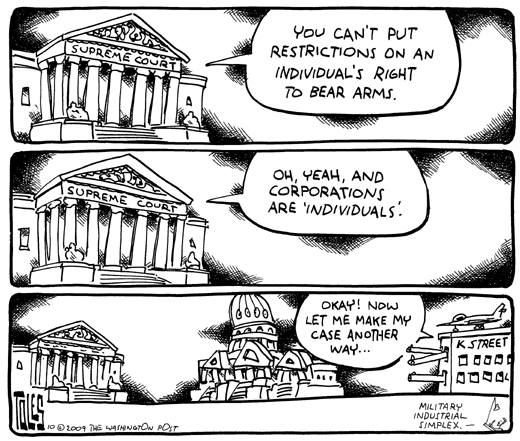
By way of explanation, the Supremes long ago extended individual rights to corporations. Attempts to limit those rights have been rejected as unconstitutional--as now seems likely in their right to spend in elections. Is their right to vote next? [Posted at 10/05/2009 07:49 AM by John T Bennett on Against Monopoly comments(4)] Patent attorney and pro-patent shill Dale Halling writes: "According to US Patent and Trademark (USPTO) Power Point presentation the allowance rate has again fallen to 41% by mid year 2009. This continues the sad trend of falling allowance rates that started in 2002."
Why is it a "sad trend"? What if there are "too many" "poor quality" patents being issued, and fewer junk patents are being allowed? [Posted at 10/02/2009 09:49 AM by Stephan Kinsella on IP Law comments(4)]  My article " Radical Patent Reform Is Not on the Way" was published today (Oct. 1, 2009) in Mises Daily.
***
Hardly a day passes when we do not hear of one patent abuse or another.[1] Ridiculous patents are issued or filed and companies are enjoined from selling their products. Judgments are issued, and settlements reached, for billions of dollars. (See the Appendix for examples of ridiculous patents and outrageous judgments.) Not surprisingly, there is a growing demand for reform of our patent system.[2]
Whether their demands are modest or radical, the reformers share the belief that the patent system is broken; has gotten out of hand; and is not in sync with our fast-paced, high-tech, open-sourced, digitized world in short, that it needs to be fixed.
FULL ARTICLE
[Mises crosspost] [Posted at 10/01/2009 07:31 AM by Stephan Kinsella on IP Law comments(1)] As I noted here, I and others have been arguing the merits of IP law with patent attorney Gene Quinn on his blog at Reality Check: Anti-Patent Patent Musings Simply Bizarre and Responding to Critics: My View on Patents & Innovation. He's laid down a challenge to debate about IP:
I challenge anyone to a debate on this topic anywhere, at any time, to be moderated by a mutually agreed panel or moderator. I know as well as everyone here that I will never be taken up on that offer. I wonder why? If I am so stupid and irresponsible and ignorant then someone take me up and prove to the world I am as such. Of course there will be no takers because in a true debate none of the nay-sayers stand any chance and would be exposed for what they truly are. Nevertheless, the challenge is made. I am sure the silence will be deafening. Or wait, even better… the response will be "there is no point in debating you because you are ." We all know that is what they are going to say, and rational people will understand that to be nothing more than cowardice.
I would be happy to debate Mr. Quinn. What I'm thinking is that we could do an Internet debate, under the auspices of a suitable institution, with a moderator, with audio and video, open to a live, world-wide audience. If anyone has any ideas or suggestions, let me know.
[Mises post; SK post] [Posted at 09/30/2009 10:34 PM by Stephan Kinsella on Is IP Property comments(0)]  Against Intellectual Property Against Intellectual Property has been been translated into Portugese ( Contra a Propriedade Intelectual) by Rafael Hotz, of the Instituto Ludwig von Mises Brasil. It was previously translated into Spanish, Polish, and Georgian. [Posted at 09/30/2009 09:29 AM by Stephan Kinsella on Is IP Property comments(0)] "It would be remarkable, and certainly unjustified, to find that the plaintiff could copyright the concept of Jesus as forgiver."
District Judge John G. Koeltl, explaining in part why one can't copyright the idea of putting Judas on trial.
Judge Koeltl even had the wisdom to award attorneys' fees to the defendant in this case, stating that there were "indicia of bad faith here."
Continuing on: "The plaintiff's first counsel was warned, before any action had been filed, that there was no colorable copyright infringement claim. The plaintiff nevertheless persisted in obtaining new counsel and filing his complaint. Furthermore, this case has the hallmarks of an abusive lawsuit."
Read the whole decision here.
[Hat-tip: CourthouseNews.com] [Posted at 09/29/2009 02:28 PM by Justin Levine on IP Law comments(0)] In his post Reality Check: Anti-Patent Patent Musings Simply Bizarre, patent attorney Gene Quinn is baffled that any patent attorney would openly oppose the patent system--or be hired by anyone. He writes, in part:
But what has me really wondering is how and why a patent attorney who is openly hostile to the patent system can get any work in the industry? Why would any inventor or company want an anti-patent patent attorney like Stephan Kinsella, who seems to be the genesis of this story, and so many other anti-patent patent stories.
Why would anyone hire me? I've prosecuted hundreds of patents. I've taught computer law as an adjunct law professor, I've published a great deal of legal scholarship including IP law, such as the Oxford University Press legal treatise Trademark Practice and Forms. I believe that given the patent system, tech companies have no choice but to arm themselves with patents, if only for defensive purposes. If someone went after one of my clients for patent infringement, I'd pull out all the stops to defend them from this state-backed threat. Maybe some clients like a patent attorney looking out for their interests.
Apparently Quinn thinks ideological conformity is a requirement for job competence. If you have the wrong politics, you're out. (I just hope I don't have the wrong religion, gender, or race.) But think about it: would you hire only oncologists who were pro-cancer? Is it outlandish to think of hiring a tax attorney to defend you from the IRS who thinks the income tax is immoral and should be abolished? Is it required of a patent attorney to be in favor of the patent system? Yes, we patent attorneys learn the patent law and how to navigate the system. Does that mean we receive special education--or is it propaganda--as to the justifiability of IP? If so, where is it? Sure, we are taught in law school that the stated purpose of the patent system is to encourage innovation, and public disclosure of inventions. Okay. So what? How does knowing the state's line for a given law prove that it is justified?
The truth is most patent attorneys are in favor of patent law. Why is this? They have no special knowledge about its normative validity. Rather, they are self-interested, and have been subjected to positivist, statist, empiricist propaganda in law school. Quinn tries to turn this defect into an advantage by hogging to the biased patent profession the right to pronounce on these matters--and then ejecting from the profession anyone who bucks the union line. The patent bar of course lobbies for the system that butters their bread. They claim special knowledge to pronounce that the system is "necessary" for innovation, even though they have no proof of this. (See below.) They marginalize non-lawyers as not having enough expertise to weigh in. And anyone who does have expertise is ostracized if they point out that the emperor is wearing no clothes. They remind of leftists who will not tolerate an African American who opposes affirmative action--they impose their supposed "benefit" on him by force, which is bad enough, and then use this imposed "benefit" to silence his criticisms of it. Terrible. (See An Anti-Patent Patent Attorney? Oh my Gawd!.)
But though patent practitioners have an interest in promoting the system that supports them--just as FDA bureaucrats support the FDA, just as government school teachers tend to be in favor of government schooling, just as policemen and state judges are in favor of the state's monopoly over justice--not all are won over by the propanda. Some just chug along, earning a living, while ignoring the cheerleading about how great our patent system is. In fact, I am not the only patent attorney who opposes the patent system. My friend Tony Diehl, a registered patent attorney, is opposed to it, and knows what a state boondoggle it is. As I noted in The Morality of Acquiring and Enforcing Patents, law professor Michael Davis, also a registered patent attorney, opposes the patent system (for leftist reasons, I believe, unlike my own pro-property, libertarian reasons--but still); and Daniel Ravicher, Executive Director of the Public Patent Foundation (PUBPAT) and Legal Director of Software Freedom Law Center, and also a registered patent attorney, appears to be opposed to patents or at the very least has serious reservations. And no doubt many patent attorneys know the standard justifications given for the system are nonsense, but they don't speak out because there is nothing to be gained from this except denunciations from cheerleaders like Quinn who will try to harm their livelihoods by telling clients not to hire them. So many are anonymous. As I wrote in Miracle--An Honest Patent Attorney!, I received at one point an email from a respected patent attorney, a senior partner in the patent department of a major national law firm. He/she insisted on anonymity--gee, I wonder why? He/she is not a libertarian. These are just his/her honest observations based on his/her long experience in the field:
Stephan, Your letter responding to Joe Hosteny's comments on Patent Trolls nicely states what I came to realize several years ago, namely, it is unclear that the U.S. Patent System, as currently implemented, necessarily benefits society as a whole. Certainly, it has benefited [Hostey] and his [partners] and several of their prominent clients, and has put Marshall, Texas on the map; but you really have to wonder if the "tax" placed on industry by the System (and its use of juries or lay judges to make the call on often highly complex technical issues that the parties' technical experts cannot agree on) is really worth it. Of course, anyone can point to a few start-up companies that, arguably, owe their successes to their patent portfolios; but over the last 35 years, I have observed what would appear to be an ever increasing number of meritless patents, issued by an understaffed and talent-challenged PTO examining group, being used to extract tribute from whole industries. I have had this discussion with a number of clients, including Asian clients, who have been forced to accept our Patent System and the "taxes" it imposes on them as the cost of doing business in the USA. I wish I had the "answer". I don't. But going to real opposition proceedings, special patent courts with trained patent judges, "loser pays attorney fees" trials, retired engineers/scientists or other experienced engineers/scientists being used to examine applications in their fields of expertise by telecommuting from their homes or local offices throughout the Country, litigating patent attorneys providing regular lectures to the PTO examiners on problems encountered in patent infringement cases due to ineffective or careless examination of patent applications, and the appointment of actually qualified patent judges to the CAFC, may be steps in the right direction.
Now this is an honest patent attorney. As I told him/her,
What is worse, to me, is when patent attorneys pretend to know, but of course, do not--and they know they do not, and they do not care. It is just dishonest. I don't mind a patent attorney being in favor of the system for the honest reason that it benefits him and his clients. Just like retired people benefit from social security even if it's an inefficient or unethical system. Or if patent attorneys just did their job and shut up about the "benefit" of the system. I will say that my point (not really in the letter, but expressed elsewhere -- e.g., There's No Such Thing As A Free Patent) is not only that is the system now probably "not worth it," but that due to the subjective nature of value, it would never be possible to demonstrate that it is "worth it". But that is a methodological point beyond most patent attorneys, who are utterly imbued with scientism and positivism.
And I have other patent attorney friends who skeptical as well. I've had dozens of conversations with patent attorneys, many of whom are mouthing the standard pro-patent line. I simply ask them, how do you know we need a patent system? How do you know the benefits accruing from it are greater than the costs of the system? What are these benefits, in dollar terms, what are the costs, and what is the net? I am always met with blank stares.
But let's return now to Quinn's screed:
My intention is not to get into a back and forth joust with those who believe the patent system does not spur innovation. In my experience there is simply no talking to people who hold those beliefs. They will hold those beliefs forever despite any and all evidence to the contrary, despite the laws of economics, the sensibilities and demands of investors and with total disregard for history itself.
It is in fact quite the reverse. Patent lawyers repeat over and over the state's propaganda that IP is necessary for innovation. They believe that we are made overall better off by the patent system. This means that the value of the extra innovation spurred by having a patent system far outweighs the undeniable costs of the system. Okay--then what are these numbers? What is the net benefit of the patent system? Is it a billion dollars? A trillion? How does Quinn know it's not negative? If he knows it's a positive number, what is his evidence for this? I don't know the costs. I don't know the value of the benefits. (My educated guess is that the net cost is over $41 billion per year. But who knows?) I do know that every study that comes out concludes otherwise (see my post Yet Another Study Finds Patents Do Not Encourage Innovation). They are the ones in favor of the granting of state monopolies. The burden is on them, not on opponents. So where is their evidence?
They don't pretend to know. They don't take this seriously. They don't have any idea of the costs, or the benefits, or the net. They don't care about the costs--costs (patent lawyers' salaries, say) are benefits to them, you see. They most they will do is trot out some off-the-cuff, non-serious remark that western countries are more prosperous and have patent systems; or we have had economic growth in America, coinciding with the patent system's implementation. Wow. How rigorous. Never heard of the idea that correlation is not causation? Maybe the pro-property industrialized countries tend to tax and war and regulate and impose patent systems because they can afford it. (See Interactive Graphic Pretends to Illustrate How U.S. Patent System Has Driven American Economy; Prove that would have been invented without patents!.)
Back to Quinn:
Yet, I have to confess at being extremely interested in knowing how a patent attorney could come to such beliefs. Kinsella is used as a propaganda tool by anti-patent folks everyone who point out "even a patent attorney knows patents stifle innovation." How is it possible that a patent attorney could believe that innovation would occur faster without patents?
The truth is we anti-IP libertarians have sincere, serious, good reasons to believe patent rights are false rights that do harm. See, e.g., my The Libertarian Case Against Intellectual Property: A Concise Guide; and other libertarian IP publications. If anything, my experience in the patent field shows me how much waste there is. It shows me what a threat to free enterprise patents are. It shows me that larger companies are just using this latest state monopoly grant as a tool to bludgeon smaller companies.
Quinn then disingenuously argues that if you are against patents, you are against technology:
The truth is that every civilization that dominated had advanced technology and innovation when compared with competing civilizations. Whether there were patents or not, advanced technology and innovation is something to be aspired to. Rather than choosing to tax the people and require free labor by unfortunate classes of people our nation has evolved to tap into one of the most fundamental and powerful motivation forces greed! Because of greed individuals, investors and companies will devote substantial amounts of time, energy and funding to come up with whatever is next, whatever is better and whatever will make them money. If we don't want a patent system and we still want the jobs innovation creates, the lifestyle advances that innovation creates and the life-saving drugs and treatments that innovation creates we need to dig deep into the greed gene and exploit it.
Yes, "greedy," self-interested behavior is fine and good. I'm in favor. I'm a libertarian, after all. The problem with patents is not that they are too capitalistic: it's that they are state privileges that intrude on the free market. I oppose patents because they undercut private property rights, not because they are private property rights.
And of course, technology and innovation is good. The mistake here is thinking there is market failure: that without the state's interventions, there won't be enough innovation. How anyone can honestly think the state can intervene and make things better is beyond me.
... I find it flat out bizarre that anyone could be of the opinion that patents stifle innovation. The truth is patents stifle innovation by the lazy, who would have never innovated anyway. Innovating is not for the faint of heart, and certainly not for the lazy, so why do we at all care what the anti-patent zealots think would happen in an unrealistic fantasy world where everyone simply works hard for the betterment of mankind and to assist others without regard to their own well-being or financial interest.
If Quinn does not understand why people can believe patents stifle innovation, he can do a bit of reading. He can start with the list of study after study concluding otherwise, collected in Yet Another Study Finds Patents Do Not Encourage Innovation; then he can read my The Libertarian Case Against Intellectual Property: A Concise Guide; and for a detailed examination of the utilitarian aspects of patents and why they discourage innovation, he can see Boldrin and Levine's magisterial Against Intellectual Monopoly (free version online).
As for lazy--was RIM lazy when it heroically innovated and provided the magnificent Blackberry to tens of millions of customers, only to have over $600M extorted from it by a patent thug? Is the ever-innovating young company Facebook "lazy"--if they don't pony us hundreds of millions of hush money to the patent predator nipping at it? Or is it rather than larger companies can rest on their laurels, protected from competition from smaller, hungrier startups, because their arsenal of patents allows them to achieve detente by thread of MAD with other, large, patent-hoarding companies, but to threaten startups who don't usually have strong patent portfolios?
Update: I and others posted several good comments to the thread Reality Check: Anti-Patent Patent Musings Simply Bizarre. Quinn has posted a followup: Responding to Critics: My View on Patents & Innovation. His post makes it clear that it's not worth responding to him any more.
Update 2: Good post by Mike Masnick on Techdirt: Is It So Crazy For A Patent Attorney To Think Patents Harm Innovation?
[SK cross-post; Mises cross-post] [Posted at 09/29/2009 12:49 PM by Stephan Kinsella on Patent Lawyers comments(7)] So, now we even have an IP-Czar (how about "Czarina", at least? Ah, the foreign languages ...).
Good, or bad? No idea. I looked around the web and could not figure out why Ms. Espinel is the appropriate person for this job. Visiting Assistant Professor at George Mason and Assistant U.S. Trade Representative for Intellectual Property is not exactly a lot, but one never knows ... Oh, right, she is also the president of some lobbying group working to empower Americans to obtain the full benefit of their creativity and ingenuity. That sounds like a program, indeed.
Anyone out there has any idea about her views, writings, previous actions taken, professional experience and knowledge of the matter?
Mine is just plain curiosity: a Czarina is supposed to be a very powerful person, after all, so it would be nice to have some track-record somewhere. [Posted at 09/29/2009 12:17 PM by Michele Boldrin on Intellectual Property comments(1)] current posts | more recent posts | earlier posts
|
|


|