Against Monopoly
defending the right to innovate
Monopoly corrupts. Absolute monopoly corrupts absolutely.
Copyright Notice: We don't think much of copyright, so you can do what you want with the content on this blog. Of course we are hungry for publicity, so we would be pleased if you avoided plagiarism and gave us credit for what we have written. We encourage you not to impose copyright restrictions on your "derivative" works, but we won't try to stop you. For the legally or statist minded, you can consider yourself subject to a Creative Commons Attribution License.
current posts | more recent posts | earlier posts
A Modest Plea
[Posted at 10/26/2008 09:02 AM by David K. Levine on Against Monopoly  comments(12)]
More financial crisis stuff
Here is a summary of what I think:
Chari, Christiano and Kehoe's paper ends with a plea for policy makers to share their data with the public. I agree with them entirely. Our two top policy makers Poulson and Bernanke have been acting as if the world is coming to an end without explaining why. Their behavior is the worst behavior by central bankers I have seen during my career as an economist. There have been days of complete chaos and panic on the stock market, and at no time have either of the two bothered to appear on television to explain to the general public what they think is going on. Bernanke speaks to no one and Poulson only to bankers. The two of them have indicated at various times that the problem is so severe that if things in the financial sector aren't fixed within periods as short as a day or a week the economy will collapse. They have never come close to giving an adequate explanation of why they have these beliefs. Two explanations come to mind: they don't know what they are doing, the conclusion that I and I think the markets have reached, or that they know something we don't know. If it is the latter it is long past time they explain what it is.
Academic economists have pored over the public data and have concluded that there is both a crisis in the financial sector and the beginning of a recession. The only obvious linkage between the two is that the recession has caused asset prices to fall putting enormous stress on the financial sector. Poulson and Bernanke apparently believe that the financial sector is either causing or aggravating the recession.
Chari, Christiano and Kehoe have produced the kind of report the Fed should have produced months ago. Nobody disagrees that there is stress in the financial sector. The question is why we think there are linkages to the rest of the economy. People have gone around making assertions ranging from the absurd (GM can't sell cars because it can't borrow money) to things that appear to be merely wrong (credit in the non-financial sector is drying up). Why has no U.S. government agency tried to provide clear careful reports about what is going on? Everything I have seen has been either produced by bankers in the private sector or the IMF. Most of the stuff, for example by the IMF, I can only describe as highly convoluted. Chari, Christiano and Keho seem to have approached the problem in a straightforward way. If the problem is a big one, it shouldn't take particularly esoteric forms of measurement to identify it.
Some people at the Fed argue that they receive data under confidentiality agreements that make it impossible to make public. Chari, Christiano and Kehoe and I are not pleading for proprietary data to be made public in whole lots. I'm sure that summaries can be made public in a useful way. If the private data simply says the same thing as the public data in a more detailed way: the Fed should say that in a clear way so that the (widespread) idea that Bernanke and Poulson are seeing some sort of data that indicates the opposite of what every one else sees can be put to rest.
I have more to say on the subject of data than that. When I was at the Minneapolis Fed on Friday I tried to get some bond rating data. It turns out this requires a subscription that the Minneapolis Fed does not have. Frankly it is pretty absurd that a government agency charged with regulating the banking sector has to pay to get rating agency data. But I'll say more than that. The Fed long ago should have gone in and demanded to see the balance sheets of banks and if there was a lemons problem tried to solve it the obvious way by telling the world who the losers and winners were. I understand in normal times the Fed and Treasury is deferential to the sector it regulates. The idea that these guys need $700 billion of public funds to bail them out, but can't reveal secrets by opening their books to the public is offensive.
As to what is really going on: It has seemed to me since about 2006 when the price of oil skyrocketed that a severe recession was not an unlikely outcome if the price rise was due to anything other than a short-term production hitch. Short term elasticity of output for commodities being what they are, prices are very sensitive to demand. As the price skyrocketed on expectations of future growth, now they are dropping on expectations of future lack of growth. It will require a 50% further decline in the price of oil to get it back to the peak price during the decade of 1990-2000. Nobody can say for sure that its "all oil" or "all financial" causing the recession. But there is at least as much reason to believe it is oil as financial.
So what is my creative plan for dealing with the mess? The goal seems surely to be first and foremost to avoid doing things that will make things worse, and second not inventing new and crazier plans every day - as Poulson spent several weeks doing - but to try to understand what plans might have actually worked in the past. In the last several weeks I've learned what did work in Chile and what didn't work in Japan. There is evidence in both cases that fixing the banking sector led to recovery of the real sector - although as usual cause and effect are hard to distinguish: the reforms may have worked because the real sector was recovering anyway. But there is no reason not to fix the financial sector. We know what the problem is: allowing failed managers of zombie banks to maintain fictitious balance sheets. As long as this continues nobody is going to be eager to lend to the banking sector. The solution is straightforward - the managers who incurred the losses need to be fired, and the losses clearly assigned to share-holders, bond-holders, and tax-payers. This is what the private sector would do in the absence of government regulation. It can be done in the current regulatory regime by forcing banks into bankruptcy by enforcing existing regulations (i.e. mark to market enforced ruthlessly), but bankruptcy proceedings are not an expeditious way to restructure the banking sector. In Chile they nationalized the banks, fired the managers, restructured the debt apportioning the losses, then sold the newly recapitalized banks back to the private sector. If we want to fix the financial sector here we need to do the same. Or we can follow the Japanese model - spend $400 billion buying preferred share in banks, and then wait and pray. The Japanese waited nearly a decade before they finally gave up and passed a law offering the opportunity to accountants who claimed firms were solvent to go to jail when it turned out they weren't.
[Posted at 10/26/2008 08:56 AM by David K. Levine on Against Monopoly comments(5)]
Fifteen minutes of fame
[Posted at 10/26/2008 08:36 AM by David K. Levine on Against IM comments(0)]
Latest TIIP is out
[Posted at 10/26/2008 08:30 AM by David K. Levine on Innovation comments(0)]
Scribd Version of Against Intellectual Property
[Posted at 10/26/2008 08:12 AM by Stephan Kinsella on Intellectual Property comments(0)]
McCain wants party right to copy as fair use
The incident has led the campaign to assert that the election is upon us and it can't wait for the issue to be adjudicated, so it should receive priority treatment. YouTube doesn't want to be forced to make the judgment on fair use. The Electronic Freedom Foundation opposes special treatment for political groups and wants uniform and extended fair use for all.
Hansell observes that given the unlikelihood of McCain's winning the election, he may never have the chance to lead the move to change the DMCA.
But this experience once again illustrates the fundamental absurdity of this law and more broadly, of copyright.
[Posted at 10/20/2008 09:10 AM by John Bennett on Fair Use comments(0)]
Microsoft patents automated censorship; Works as well as Windows
I ask myself if MS is serious with this patent. The probability of false positives or altering meaning is high so that I can see damage suits arising. I also read the patent as being a hunting license rather than an existing device and ask myself why it was granted. The patent itself notes that a delay in transmission with humans reviewing the speech to determine offense has generally worked. Is this MS in its latest guise as patent troll?
The Patent Office seems to have lost all sense.
[Posted at 10/19/2008 11:28 AM by John Bennett on Patents (General) comments(2)]
Off topic for your amusement
[Posted at 10/17/2008 07:59 PM by David K. Levine on The State and IP comments(1)]
Does the Piracy Paradox apply for Patents?
Does the Piracy Paradox apply for Patents?
"A 2006 paper by Kal Raustiala (UCLA) and Chris Sprigman (UVA) titled the Piracy Paradox discusses intellectual property and the fashion industry. The authors conclude that the legal ability of manufacturers to create knock-off versions of fashion designs actually promotes innovation and investment in that industry. Similar phenomena have been explained in other industries. In music, for instance, some studies have shown that peer-to-peer file sharing of copyrighted work actually increases sales because of the increased popularity of the artist. Since the dawn of radio, record companies have paid stations to broadcast their music - even though the broadcast would be considered infringement.
"My question is whether there are patent specific examples of this process going on? Are there times when 'piracy' of a technology actually encourages further R&D?"
[Posted at 10/16/2008 12:03 PM by Stephan Kinsella on Patents (General) comments(0)]
Under the dark of night
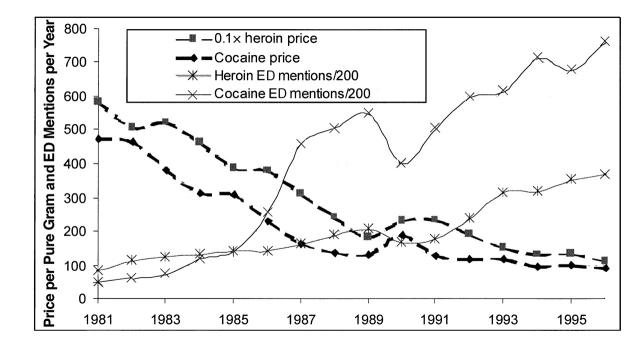
(graph from the American Journal of Public Health)
The position of drug czar was created in 1982 (according to Wikipedia). The dark lines are the prices of cocaine and heroin which have been falling ever since. Does the creation of a "czar" position mean that they have given up hope?
Addendum: There is something else interesting in that graph. One industry that operates entirely without the "benefit" of patents and copyright is the illegal drug industry. Yet it is a very innovative industry. For starters, as can be seen in the graph, prices have dropped quite a bit - over 15 years by a factor of about 5 (a little more allowing for inflation). Few industries can match that. And we know that there have been significant innovations: the invention of crystal methamphetamine; rock cocaine; stronger strains of marijuana and so forth. And presumably there have been innovations in methods of smuggling drugs into the country. Clearly these have been widely imitated. Which brings up the question: maybe if the government legalized recreational drugs, but subjected them to the same type of patent restrictions as ordinary pharmaceutical products - the price would go up instead of down?
[Posted at 10/13/2008 07:43 PM by David K. Levine on IP in the News comments(10)]


Most Recent Comments