Copyright Notice: We don't think much of copyright, so you can do what you want with the content on this blog. Of
course we
are hungry
for publicity, so we would be pleased if you avoided plagiarism and gave us credit for what we have written. We
encourage you not to impose copyright restrictions on your "derivative" works, but we won't try to stop you. For the legally or statist minded,
you can consider yourself subject to a Creative Commons Attribution License. |
|
current posts | more recent posts | earlier posts The audit of the AIG bailout is now out link here. Mary Williams Walsh summarizes it here link here.
One can forgive some of the failings in light of the pressure to reach a deal that preserved the financial system. But not all. Once again, one has the feeling that the long arm of the epitome of Wall Street, Goldman Sachs, has produced a "solution" that was very good for it. Examples:
**No real effort was made to get the companies benefiting to take less than the book value of their loans. The Goldman argument that it had successfully hedged its deals with AIG and deserved to be fully compensated is faulted, on grounds that the hedges would not have survived the almost certain meltdown.
**The FED considered itself an AIG creditor rather than a regulator and "could not impose its will on banks but instead asked for voluntary concessions," in contrast to the auto bailout where the terms were crammed down them. Moreover it decided it could not treat foreign banks differently from domestic banks for fear of retaliation.
**Some banks argued that they could not legally take less than the contracted amount unless AIG declared bankruptcy, a long judicial proceeding that had to be avoided.
**The authorities insisted on secrecy to prevent the collapse from spreading but that was mistaken as whenever public funds are spent, the public is entitled to know.
[Posted at 11/17/2009 01:00 PM by John Bennett on Financial Crisis  comments(1)] comments(1)]  My article Intellectual Property and Libertarianism was published last month in Liberty magazine (December 2009 issue). This article is based in part on a speech at Mises University 2009 (July 30, 2009; audio; video) and also on my What Libertarianism Is, which contains references not present in the Liberty paper (as does The Case Against IP: A Concise Guide). A version with endnotes was published here in Mises Daily. [Posted at 11/17/2009 09:27 AM by Stephan Kinsella on Libertarian Perspectives comments(1)] [Posted at 11/17/2009 07:03 AM by John T Bennett on Copyright comments(0)] 
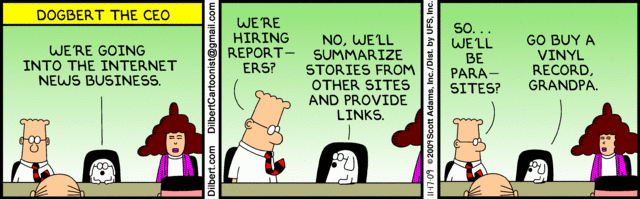
For $100 I could license a copy for this website but only for 12 months. So I'm linking to the image instead. [Posted at 11/17/2009 05:21 AM by David K. Levine on Patent Lawyers comments(2)] In Jeff Tucker's superb article If You Believe in IP, How Do You Teach Others?, he notes Rand's increasing focus on exalting the creator and elevating "intellectual rights" to such a height that they totally trump real rights. This is no exaggeration. As I noted in Against Intellectual Property, Rand actually, incredibly said that " patents are the heart and core of property rights." See also my post Inventors are Like Unto .... GODS....., noting Objectivist IP attorney Murray Franck approvingly repeating this quote: " intellectual property is after all the only absolute possession in the world."
So, yes, Objectivists focus on the creation of value, and thus in rights in value, and explicitly drop the connection between property rights and scarcity. As I note in footnote 76 of Against Intellectual Property, Objectivist David Kelley wrote:
Property rights are required because man needs to support his life by the use of his reason. The primary task in this regard is to create values that satisfy human needs, rather than relying on what we find in nature, as animals do. . . . [T]he essential basis of property rights lies in the phenomenon of creating value. . . . Scarcity becomes a relevant issue when we consider the use of things in nature, such as land, as inputs to the process of creating value. As a general rule, I would say that two conditions are required in order to appropriate things in nature and make them one's property: (1) one must put them to some productive use, and (2) that productive use must require exclusive control over them, i.e., the right to exclude others. . . . Condition (2) holds only when the resource is scarce. But for things that one has created, such as a new product, one's act of creation is the source of the right, regardless of scarcity. [emphasis added]
Letter on Intellectual Property Rights, IOS Journal 5, no. 2 (June 1995), pp. 12-13 (including: David Kelley, "Response to Kinsella," IOS Journal 5, no. 2 (June 1995), p. 13; and Murray I. Franck, "Intellectual and Personality Property," IOS Journal 5, no. 3 September 1995), p. 7.
Thus, Objectivists will talk about man creating values. For them "a value" is a thing that exists; it's what you "create". For the Austrian and Austro-libertarian, you don't talk about "a value" as if it's an existing thing that you create. I don't make a value. For us, it's more of a verb: we value things as ends or as means to ends. We can make something more valuable by transforming it, but we do not create new property when we do this. As discussed in Intellectual Property and Libertarianism, creation is an important means of increasing wealth. As Hoppe has observed,
One can acquire and increase wealth either through homesteading, production and contractual exchange, or by expropriating and exploiting homesteaders, producers, or contractual exchangers. There are no other ways. [Hans-Hermann Hoppe, "Banking, Nation States and International Politics: A Sociological Reconstruction of the Present Economic Order," Review of Austrian Economics 4 (1990): pp. 55-87, p. 60. Emphasis added.] Review of Austrian Economics 4 (1990): pp. 55-87, p. 60. Emphasis added.]
While production or creation may be a means of gaining "wealth," it is not an independent source of ownership or rights. Production is not the creation of new matter; it is the transformation of things from one form to another the transformation of things someone already owns, either the producer or someone else.
By viewing "values" as things that we create, Objectivists then think there should be property rights in values. They are things, after all, right? But this is a fundamental mistake. As I noted in Objectivist Law Prof Mossoff on Copyright; or, the Misuse of Labor, Value, and Creation Metaphors, a common mistaken belief is that one has a property right in the value, as opposed to the physical integrity of, one's property. For elaboration, see pp. 139-141 of Hoppe's A Theory of Socialism and Capitalism; also see my comments re same to Patents and Utilitarian Thinking. This assumption sneaks into or lies at the basis of many fallacious notions of property rights, such as the idea that there is a right to a reputation because it can have value. It ties in with the (especially Randian) notion of "creation" as the source of rights, and the confusing admixture of the "labor" idea, when we talk about using our labor to "create" things of "value" (like reputations, inventions, works of art). As Hoppe notes in The Economics and Ethics of Private Property:
According to this understanding of private property, property ownership means the exclusive control of a particular person over specific physical objects and spaces. Conversely, property rights invasion means the uninvited physical damage or diminution of things and territories owned by other persons. In contrast, a widely held view holds that the damage or diminution of the value (or price) of someone's property also constitutes a punishable offense.As far as the (in)compatibility of both positions is concerned, it is easy to recognize that nearly every action of an individual can alter the value (price) of someone else's property. For example, when person A enters the labor or the marriage market, this may change the value of B in these markets. And when A changes his relative valuations of beer and bread, or if A himself decides to become a brewer or baker, this changes the value of the property of other brewers and bakers. According to the view that value damage constitutes a rights violation, A would be committing a punishable offense vis-à-vis brewers or bakers. If A is guilty, then B and the brewers and bakers must have the right to defend themselves against A's actions, and their defensive actions can only consist of physical invasions of A and his property. B must be permitted to physically prohibit A from entering the labor or marriage market; the brewers and bakers must be permitted to physically prevent A from spending his money as he sees fit. However, in this case the physical damage or diminution of the property of others cannot be viewed as a punishable offense. Since physical invasion and diminution are defensive actions, they are legitimate. Conversely, if physical damage and diminution constitute a rights violation, then B or the brewers and bakers do not have the right to defend themselves against A's actions, for his actions - his entering of the labor and marriage market, his altered evaluation of beer and bread, or his opening of a brewery or bakery - do not affect B's bodily integrity or the physical integrity of the property of brewers or bakers. If they physically defend themselves nonetheless, then the right to defense would lie with A. In that case, however, it can not be regarded as a punishable offense if one alters the value of other people's property. A third possibility does not exist.
Both ideas of property rights are not only incompatible, however. The alternative view - that one could be the owner of the value or price of scarce goods - is indefensible. While a person has control over whether or not his actions will change the physical properties of another's property, he has no control over whether or not his actions affect the value (or price) of another's property. This is determined by other individuals and their evaluations. Consequently, it would be impossible to know in advance whether or not one's planned actions were legitimate. The entire population would have to be interrogated to assure that one's actions would not damage the value of someone else's property, and one could not begin to act until a universal consensus had been reached. Mankind would die out long before this assumption could ever be fulfilled.
Moreover, the assertion that one has a property right in the value of things involves a contradiction, for in order to claim this proposition to be valid - universally agreeable - it would have to be assumed that it is permissible to act before agreement is reached. Otherwise, it would be impossible to ever propose anything However, if one is permitted to assert a proposition - and no one could deny this without running into contradictions - then this is only possible because physical property borders exist, i.e., borders which everyone can recognize and ascertain independently and in complete ignorance of others' subjective valuations.
Rand did have insights that militated against property rights in "values"; as she once wrote:
The power to rearrange the combinations of natural elements is the only creative power man possesses. It is an enormous and glorious power and it is the only meaning of the concept "creative." "Creation" does not (and metaphysically cannot) mean the power to bring something into existence out of nothing. "Creation" means the power to bring into existence an arrangement (or combination or integration) of natural elements that had not existed before.
She should have realized that this means there cannot be property rights in value since this would have to mean property rights in arrangements or patterns, which would then give the owner of the arrangement rights in other people's already-owned property. If she had kept her focus on the fact that rearranging already-existing property can indeed make that property more valuable, she would have realized that creation (rearrangement) is not an independent source of property rights: if you rearrange your own property, even if this makes it more valuable, you already owned the property that you have rearranged (made more valuable). Yet this does not give you rights in other people's property. You can re-word the Randian view as follows: if you make your property more valuable, it gives you additional property rights--the right to prevent other people from making their own property more valuable. And this makes it all the more obviously flawed.
This is where the Misesian approach to subjectivist value makes sense: things have value to a valuer; values do not exist independently as free-floating things that can themselves be owned. And again, Rand should have recognized this; e.g., she once wrote, "Material objects as such have neither value nor disvalue; they acquire value-significance only in regard to a living being particularly, in regard to serving or hindering man's goals." (For more on the compatibility between Objectivism and Austrian economics, see Mises and Rand (and Rothbard); Randian Hoppe(?), Austrian Rand(?).) So she should have realized that if rearranging owned property makes the owner or potential buyers value the object more, it does not mean there is any additional thing created for which we need to find an owner.
I think a similar mistake is made by Tibor Machan. Rand slips into thinking of values as ownable things because she thinks of values as created things, rather than thinking of it as a verb: people value things (and demonstrate this preference or valuing in action). I'm sure Machan would disagree with my way or framing his argument, but his argument, to me, seems to say that if you can have a concept for some"thing", or a name or word for "it," then it's an ontological "type of thing," and after all, if you create this thing, why shouldn't you be "its" owner? The problem (For more on this, see New Working Paper: Machan on IP; Owning Thoughts and Labor; this comment to "Trademark and Fraud"; Libertarian Creationism; also Elaborations on Randian IP and Objectivists on IP.)
http://aynrandlexicon.com/lexicon/creation.html [Posted at 11/16/2009 02:38 PM by Stephan Kinsella on Is IP Property comments(1)] Powerful piece by Jeff Tucker: If You Believe in IP, How Do You Teach Others?
November 16, 2009 7:43 AM by Mises Daily (Archive)
 The MIT model is the model of the ancient world and every university environment ever since, and it is the only way to deal with a digital society in which every thought becomes globalized upon utterance. FULL ARTICLE by Jeffrey Tucker The MIT model is the model of the ancient world and every university environment ever since, and it is the only way to deal with a digital society in which every thought becomes globalized upon utterance. FULL ARTICLE by Jeffrey Tucker
[Posted at 11/16/2009 07:25 AM by Stephan Kinsella on IP as Censorship comments(1)] I have been waiting for more articles, but they seem to have stopped coming. So now it is time to post a suggestion that you read what there are, listed on the right of the link here. It is a pretty strong case against Goldman Sachs totally profit oriented, self-regarding behavior put together by McClatchy news. Not a court case, I think, but one which underscores that without regulation or breaking up Goldman, a financial crisis will recur, brought on by much the same behavior:
*corrupted results from the rating agencies which produced misleading reassurances to investors.
*lending on subprime mortgages, reselling them, and betting that the housing market would tank along with the mortgages it sold.
The final irony is Goldman's current claim attacking McClatchy's series but with no specifics and asserting that it has not profited from the government's bailout of the financial sector. [Posted at 11/12/2009 08:13 AM by John Bennett on Financial Crisis comments(1)] Intel Will Pay $1.25 Billion to Settle Disputes With Rival reports: "Ending the computer industry's most bitter legal war, the chip maker Intel agreed on Thursday to pay a rival, Advanced Micro Devices, $1.25 billion to settle antitrust and patent disputes."
$1.25 billion in wealth transferred, and untold hundreds of millions spent on litigation, patent acquisition, losses due to strategic adjustments in response to antitrust and patent law ... Yet another example of how the central state's artificial legislative patent and antitrust schemes do nothing but destroy and waste wealth. Well, not only that--they also enrich certain classes who parasitically benefit from the system, e.g. patent lawyers, litigators, and large companies.
(See also my post Nokia's infringement suit against Apple illustrates need to scrap US patent system.) [Posted at 11/12/2009 08:09 AM by Stephan Kinsella on IP and Protectionism comments(1)] In Survey of the Disruptive Impact of a First-to-File Switch, and on his facebook page, patent attorney and law professor Dennis Crouch asks "patent professionals" to "Please Respond to my Survey on Switching US Law to a First-to-File System."
I'm trying to figure out why we should care what patent attorneys, of all people, think about patent policy. Why is there an assumption that their opinions on patent policy are especially relevant? If anything, patent professional are biased because of built-in incentives to favor maintaining a patent system. They are not objective at all. And training in engineering and law school in no way provides one with any special knowledge of policy or ethics issues. By analogy, do we care what an IRS agent thinks the tax rates should be? [Posted at 11/12/2009 05:53 AM by Stephan Kinsella on Patent Lawyers comments(2)] This subject will appear off-topic initially but bear with me. The Economist magazine has a long article, "Japan's technology champions," about the mid-sized highly specialized companies which dominate several manufacturing fields link here. The prime example is the world's sole maker of the huge forged pressure vessels for nuclear power plants. But there are a host of others that number among the top two or three firms in their industry. All share a characteristic attention to rigorous quality standards.
While computers, for example, have become commodities, certain components are highly technical and hard to make, like the substrate in the fabrication of chips. The article notes that for these firms, the "technology is tacit, not formal. It cannot be transmitted by writing a manual or reading a patent application. Rather it accumulates by working with colleagues over many years. This poses a barrier to entry for rivals."
Other features of these firms result, including their avoiding mergers based on the fact that the strength of the company lies in its current employees, their heavy spending on r & d, on keeping the core technology secret, on owning their supply chain, and even on manufacturing their own specialized tools.
Here again, we see that technical progress is not the result of patents or copyrights, but from the tradition of innovation that put these firms at the top of their industries. This is particularly important as economies pass from the copying and catch-up phases that we see in the emerging industrial states. The next stage is developing the innovative technical skills on which rising incomes in leading economies like the US will depend.
[Posted at 11/11/2009 09:42 AM by John Bennett on IP and Economics comments(1)] current posts | more recent posts | earlier posts
|
|


|