Against Monopoly
defending the right to innovate
Monopoly corrupts. Absolute monopoly corrupts absolutely.
Copyright Notice: We don't think much of copyright, so you can do what you want with the content on this blog. Of course we are hungry for publicity, so we would be pleased if you avoided plagiarism and gave us credit for what we have written. We encourage you not to impose copyright restrictions on your "derivative" works, but we won't try to stop you. For the legally or statist minded, you can consider yourself subject to a Creative Commons Attribution License.
current posts | more recent posts | earlier posts
What has Apple wrought?
[Posted at 08/30/2012 11:47 AM by David K. Levine on Patent Madness  comments(0)]
Apple heads towards the scrapheap of history
My view of Apple-Samsung summarized pretty well in the Financial Times. Just bear in mind that companies that build great products generally find that more profitable to compete in the market rather than in court.
[Posted at 08/29/2012 08:21 AM by David K. Levine on Patent Madness comments(4)]
Mother Goose and Grimm on prior art
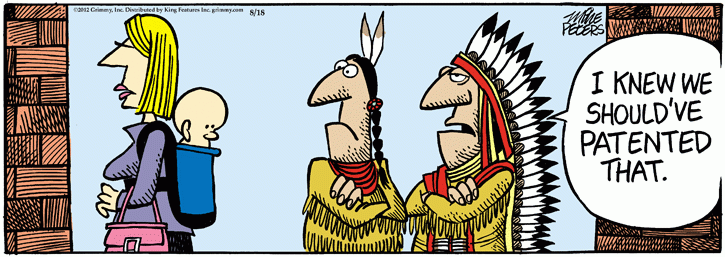
[Posted at 08/18/2012 01:24 PM by John Bennett on Patents comments(0)]
Apple v. Samsung; What is wrong with patents?
The trial, Apple v. Samsung, promises lots of fireworks. The likely entertainment value, however, is far exceeded by its educational value. The harbinger is the publication of US Judge Lucy Koh's instructions to the jury link here.
For non-lawyers like me, it is a revelation. She lays out in detail what determinations each juror will need to make and the connections among them, which she will have to decide, and the background for each where that is important.
She is breathtakingly clear, but that only raises questions about the suitability of patent law. Most of us, including many lawyers, aren't so careful to parse the meaning of legislation or the meaning of precedent in order to come to a wise decision.
It confirms in my mind the weakness of the whole justification for patents. They can be connected to innovation only weakly at best. The legal process is incredibly expensive and uncertain. The side with the most money and the best lawyers is most likely to win. And for the layman, the whole business is a puzzle once you go beneath the obvious and wonder what finally determined the outcome.
If even the best lawyers and judges can't do better than this, why continue to delude ourselves with this nonsense?
[Posted at 08/02/2012 12:38 PM by John Bennett on Patents comments(1)]
Frank & Ernest strike again

[Posted at 07/26/2012 08:09 AM by John Bennett on Copyright comments(0)]
Would books be published without copyright?
Stephen Greenblatt writes in The Swerve; How the World Became Modern, "Authors made nothing from the sale of their books; their profits derived from the wealthy patron to whom the work was dedicated. (The arrangement … seems odd to us but it had an impressive stability, remaining in place until the invention of copyright in the eighteenth century.) Publishers had to contend, as we have seen, with the widespread copying [by hand] of books among friends, but the business of producing and marketing books must have been a profitable one; there were bookshops not only in Rome but also in Brindisi, Carthage… and other cities [in the Roman empire]."
This suggests to me that books and other writings today would be produced without copyright, which is after all a government granted monopoly and an enormous tax on the public. Think about it.
[Posted at 07/04/2012 11:58 AM by John Bennett on Copyright comments(9)]
Dilbert strikes again
[Posted at 06/30/2012 04:22 PM by John Bennett on Intellectual Property comments(1)]
Another great Dilbert cartoon on IP
But he only allows me to link, not to copy and reproduce on our blog.

[Posted at 06/29/2012 07:55 AM by John Bennett on Intellectual Property comments(1)]
White House invites comment on IP enforcement
Mike Masnick passes on the invitation from the White House to let it know what we think of IP enforcement link here.
That is a great invitation and if we as critics don't respond in large numbers and with well-argued statements of our views, we will miss a significant opportunity.
Masnick goes on to note, "Victoria Espinel, the White House's Intellectual Property Enforcement Coordinator, has announced the opening of a public comment period for people to give their thoughts to the administration on what it should be doing about "intellectual property enforcement." As always happens with "public comment" periods, expect large filings from big special interests. Also, I wouldn't expect any major change to come from this. However, I would still recommend submitting carefully argued, well-thought-out filings on your thoughts concerning the White House's approach to "enforcing" intellectual property. While I do not always agree with Espinel or the administration in how it handles these things, I have found them to be very open to actually listening to concerns from people -- much more so than other parts of the government that have taken a specific view on these issues and have no interest in budging. Espinel, at the very least, is actually interested in opposing viewpoints and the more detailed, thoughtful arguments she hears, the better. The key part of her request is as follows: I believe that essential to the development of an effective enforcement strategy, is ensuring that any approaches that are considered to be particularly effective as well as any concerns with the present approach to intellectual property enforcement are understood by policymakers."
[Posted at 06/27/2012 08:51 AM by John Bennett on Intellectual Property comments(1)]
Trademarking a phrase?
Matt Yglesias calls attention to the story about a basketball player who has "trademarked" his eyebrows that are connected, leaving no empty spot above his nose link here.
Actually he seems to have trademarked the use of "unibrow" in several catch phrases. Davis told CNBC that he trademarked the phrases "Fear The Brow" and "Raise The Brow" earlier this month. "I don't want anyone to try to grow a unibrow because of me and I'll say it: Fear the brow!"
Matt adds, "Of course having a unibrow is not, in fact, unique; it's just somewhat unusual. Meanwhile, it turns out that five games into his remarkable run last season, the D.C. law firm Arent Fox swooped in to help Jeremy Lin trademark the phrase Linsanity. "
How can we top this nonsense? I am guessing it will happen soon.
[Posted at 06/27/2012 07:51 AM by John Bennett on Trademark comments(1)]


Most Recent Comments
at 07/29/2026 08:18 AM by Anonymous
at 07/29/2026 08:18 AM by Anonymous
at 07/29/2026 08:18 AM by Anonymous
at 07/29/2026 08:18 AM by Anonymous
at 07/29/2026 08:18 AM by Anonymous
at 07/29/2026 08:18 AM by Anonymous
at 07/29/2026 08:18 AM by Anonymous
at 07/29/2026 08:18 AM by Anonymous
at 07/29/2026 04:57 AM by Anonymous
at 07/29/2026 04:57 AM by Anonymous
at 07/29/2026 04:57 AM by Anonymous
at 07/29/2026 04:57 AM by Anonymous
at 07/29/2026 04:57 AM by Anonymous
at 07/29/2026 04:57 AM by Anonymous
at 07/29/2026 04:57 AM by Anonymous
at 07/29/2026 04:57 AM by Anonymous
at 07/29/2026 03:02 AM by Anonymous
at 07/29/2026 03:02 AM by Anonymous
at 07/29/2026 03:02 AM by Anonymous
at 07/29/2026 03:02 AM by Anonymous