Against Monopoly
defending the right to innovate
Monopoly corrupts. Absolute monopoly corrupts absolutely.
Copyright Notice: We don't think much of copyright, so you can do what you want with the content on this blog. Of course we are hungry for publicity, so we would be pleased if you avoided plagiarism and gave us credit for what we have written. We encourage you not to impose copyright restrictions on your "derivative" works, but we won't try to stop you. For the legally or statist minded, you can consider yourself subject to a Creative Commons Attribution License.
current posts | more recent posts | earlier posts
Open Source Games
A new blog on Gaming with Free Software by Shirish from India. He also draws our attention to copysouth.org - addressing some of the same issues we consider here.
[Posted at 06/05/2010 08:21 AM by David K. Levine on Blogroll  comments(0)]
World War 0
I have been meaning to post about some remarkable research by Eckhard Hoeffner for a while, but only now have time to do partial justice to it. Eckhard identified a nearly perfect natural experiment about the impact of copyright:
In 1815 the German confederation consisted of 39 states with no effective copyright. At that time Great Britain was a monolithic state in which the well enforced copyright had just been extended to 28 years or the life of the author. Germany was a bit larger in population about 27 million against 17 million, but population in England was growing much more rapidly, was concentrated in urban areas and England was a much richer nation. So many more titles were produced in England obviously with all that extra incentive from copyright.
A picture speaks louder than words
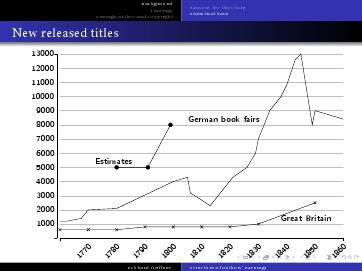
Eckhard goes on to analyze how authors fared with and without copyright. The bottom line: the journeyman author - those who produce most of the books - did better without copyright. The big guys at the top? They did better with copyright.
For all the details you can find Eckhard's slides here, and I am sure more is to come.
[Posted at 06/05/2010 08:09 AM by David K. Levine on Copyright comments(49)]
Is this what they mean by analog hole?
Having trouble with DRM on your ebooks? Try this site. The problem with DRM is it encourages piracy. It can always be removed - but it can be a hassle. So: if you are going to distribute it widely it is worth the effort - and if you take the trouble to do it yourself you are so pissed off that you feel a strong temptation to share it. Irritating your customers hasn't proven a winning business model in the past.
[Posted at 06/05/2010 07:54 AM by David K. Levine on Was Napster Right? comments(1)]
Canada to "modernize" copyright law
It's official. The Federal Government of Canada unveiled Bill C-32 this afternoon; it places emphasis upon the sanctity of technological protection measures (TPMs). Michael Geist gives the Reader's Digest version. He points to some good news, including: ISPs retain the notice-and-notice system (that they have informally been working under for years); fair dealing has broadened modestly (parodic and some educational uses would be included); and some other consumer-friendly provisions are proposed (I think it will finally be lawful to video-tape a television program and watch it later.) However, if circumventing a TPM is involved, all bets are off.
For those of you who have been counting, this is the third effort, in the past five years, by Canada to amend the Copyright Act. The previous two each died on their order papers - victims of Parliamentary instability. That is unlikely to happen this time. It appears the government will endeavor to fast-track the bill into law.
[Posted at 06/02/2010 01:29 PM by Meera Nair on Copyright comments(13)]
Google vs Apple; Is there room for both?
James Kwack writes about the face-off between Google and Apple for control of personal computing, in what at first sight is not germane to the usual subject matter of this blog, but bear with me--in the end, it is about competing monopolies based on different technologies and patents and copyrights link here. In the first of a two part blog series, he describes the evolution of the personal computing and in the second he picks up the appearance of cloud computing and its meaning for the competitive battle. The cloud is Google's realm and the personal computer and associated gadgets like the iPod, iPad, etc. are Apple's. Microsoft is the also-ran in this competition since it seems likely to become increasingly irrelevant to the long-run result.
The key to the Apple strategy is to make the Mac and its spun off gadgets as proprietary as possible, so that owners of the cool gadgets must buy the software which however cannot be used on other makers' hardware, producing a lock-in. Google on the other hand has made the operating system increasingly irrelevant on the PC since it has Windows substitutes in Android and Chrome. While its operating systems are open, its monopoly power derives from its dominance over advertising on the web which it can retain as long as it retains its premier standing in Search software.
On the basis of cost to consumers, it would seem preferable for Google to win this test, but not completely, with the Macs retaining some part of the market based on coolness but at higher prices. In the end, it does not seem quickly apparent that government intervention will provide any consumer benefit, since this industry has fundamental aspects of a natural monopoly, giving the two protagonists a hefty advantage over potential competitors. But each must retain its lead by continuing to innovate.
[Posted at 06/01/2010 06:23 AM by John Bennett on Monopolistic Competition comments(0)]
Letter to MacBreak's Scott Bourne about Open Source and the Free Market
 Dear Mr. Bourne,
I've been enjoying your commentary on various Twit network podcasts for a while now. On the recent MacBreak Weekly, I found your exchange with Merlin Mann about open source interesting. I detect a whiff of libertarianism in your remark about the force of the state being used to enforce taxes--which I appreciate, as I'm a libertarian myself. I'm also a patent attorney and have written extensively about why patent and copyright law are anti-free market and unlibertarian (my reasons may be found at The Case Against IP: A Concise Guide, available at http://www.stephankinsella.com/publications/#IP).
You are right, in a way, that the free market will come into play here--but the power of patent and copyright holders is not a free market power. It is an artificial and unjust monopoly given to them by the state, which they then use in the courts to get the force of the state (as with tax collection) to extort money from third parties. So, given this monopoly power, yes, the free market will temper somewhat how much they can extort from people, but still, it's unjust and greatly distorts the market. It also leads to hostility against the free market when people wrongly identify this state monopoly granting practice as part of the free market.
That said, I agree with you that there is no "religious" reason for a given individual or firm to use open source over non-open -- whatever works better and is the better deal for you, of course. And in fact the "open source" model is not without problems: it also relies on copyright, and has insidious aspects -- that's one reason I, as an anti-copyright type, prefer public domain or creative commons attribution only instead of the share-alike/GNU type model (which I explain in Copyright is very sticky!, Eben Moglen and Leftist Opposition to Intellectual Property, and Leftist Attacks on the Google Book Settlement).
[Posted at 05/27/2010 09:20 AM by Stephan Kinsella on Open Source comments(0)]
Roderick Long Finally Realizes IP is Unjustified
 Well, back in 1995, that is :) See his post Bye-Bye for IP, an excellent short critique of "intellectual property." As I noted in the comments, I think I tied him in coming to my senses about IP: I believe my first published piece against IP was in 1995 as well in the IOS Journal. There may have been something earlier; I'm not sure. I may have presented something a bit earlier at some Federalist Society meetings in Philadelphia; the next thing I can find that I published was in 1998 for the Pennsylvania Bar Association Intellectual Property Newsletter (later republished in a Federalist Society online forum).
The 1995 publication followed on the heels of my taking the patent bar exam in 1994. I had been thinking about IP for a long time, since 1987 or so at least, because Rand's defense of IP had always bugged me. I started thinking about it harder in 1992 or so, when I started practicing IP law.
Good times.
[Posted at 05/25/2010 01:16 PM by Stephan Kinsella on Is IP Property comments(0)]
Supreme Court: NFL Not Immune From Anti-Trust Lawsuits
Justice Stevens proves to be the go-to Justice once again when it comes to IP issues on the Supreme Court.
It just released a unanimous decision that he authored, holding that the NFL can be sued for anti-trust violations for trying to give exclusive manufacturing licenses for producing trademarked clothing with NFL logos on them.
(It doesn't rule on whether the lawsuit will be ultimately successful or not, only that the NFL isn't immune from such lawsuits.)
Read the decision here:
http://www.scribd.com/doc/31867867/No-08-661-American-Needle-v-NFL
(A harbinger of the forthcoming Bilksi patent decison? We shall see...)
[Posted at 05/24/2010 01:14 PM by Justin Levine on IP Law comments(3)]
Fund raising for feature documentary - Who Owns You?
As I noted previously, I was interviewed recently for a promising new documentary by lawyer-philosopher David Koepsell and filmmaker Taylor Roesch, "Who Owns You?" (Here's the first trailer, on Vimeo.) Here's an email I just received from Taylor:
Hello Family and Friends,As you may or may not know, for the last eight months, I have been filming a documentary on the subject of human gene patenting with David Koepsell, philosopher and author of the book Who Owns You? The Corporate Gold Rush to Patent Our Genes. We have made great progress since last October, filming numerous interviews with genetic counselors, patent attorneys, and the one and only James Watson. Currently, we have over 35 hours of footage and expect to film another 35 hours this summer. Below is a link to the trailer for the documentary:
Our film has nicely dove-tailed with the recent court case between the Myriad Genetics, patent holder of genes BRCA1 and BRCA2 (which contribute to breast cancer), and the ACLU as well as numerous individuals and clinical organizations. At the beginning of April, the honorable Judge Sweets of the Federal District Court in New York, ruled in favor of the ACLU, making Myriad's patents invalid. Initially, this was great news! Not only had the ACLU won this case, but my film had an ending. My celebration was premature because Myriad has decided to appeal the decision. The case is currently in the Appellate Court and both sides intend on taking it to the US Supreme Court. It will be years before a final decision is reached. If we can spotlight this issue in the public square, it will help build public support for the lower court's decision, and perhaps the Appellate Court and Supreme Court will uphold the recent ruling.
But there is more at stake than this one case, over 20% of the human genome has been patented. While the ACLU case highlights this problem, there are still many questions about whether it will invalidate all of these sorts of gene patents.
We have some great people willing to help us as you can see from our trailer but there are still a lot of costs involved in finishing the film. We need additional funds to conduct more interviews in Chicago, Washington DC, Berkeley CA, and The Netherlands. After we finish filming this summer, post production will begin and a final product should be ready by December 2010. We have financed much of the work ourselves, but we will need at least $3,000.00 to complete this important film. Any money you can contribute will go a long way to getting this documentary done and this issue heard. Please feel free to send this email along to anyone you think might be interested in helping us out.
Below is a link to our Kickstarter website where you can easily donate to our project:
Your Genes Have Been Patented - A Feature Documentary titled Who Owns You?
Thank you very much,
Taylor Roesch (757) 817-5052 TaylorRoesch@gmail.com
[Posted at 05/24/2010 11:58 AM by Stephan Kinsella on gene patents comments(1)]
Appeals Court Halts ‘Hot News' Publishing Order
A federal appeals court on Thursday lifted a lower court's order that a well-known financial news aggregator delay the re-publication of prominent financial analysts' buy and sell recommendations.
Read More here: http://www.wired.com/threatlevel/2010/05/hotnews/#ixzz0oXrOdgIT
The courts need to drive a stake through the heart of the bogus "hot news" doctrine. The fact that it has even got this far through the court system is a disgrace. It represents a clear and present danger to the First Amendment which needs to be beaten back hard.
[Posted at 05/21/2010 12:06 AM by Justin Levine on IP as Censorship comments(0)]


Most Recent Comments
at 07/29/2026 08:18 AM by Anonymous
at 07/29/2026 08:18 AM by Anonymous
at 07/29/2026 08:18 AM by Anonymous
at 07/29/2026 08:18 AM by Anonymous
at 07/29/2026 08:18 AM by Anonymous
at 07/29/2026 08:18 AM by Anonymous
at 07/29/2026 08:18 AM by Anonymous
at 07/29/2026 08:18 AM by Anonymous
at 07/29/2026 04:57 AM by Anonymous
at 07/29/2026 04:57 AM by Anonymous
at 07/29/2026 04:57 AM by Anonymous
at 07/29/2026 04:57 AM by Anonymous
at 07/29/2026 04:57 AM by Anonymous
at 07/29/2026 04:57 AM by Anonymous
at 07/29/2026 04:57 AM by Anonymous
at 07/29/2026 04:57 AM by Anonymous
at 07/29/2026 03:02 AM by Anonymous
at 07/29/2026 03:02 AM by Anonymous
at 07/29/2026 03:02 AM by Anonymous
at 07/29/2026 03:02 AM by Anonymous